The Karajia Sarcophagi are one of the most unusual archaeological sites in Peru. Hidden high on a limestone cliff in northern Peru, these remarkable cliff tombs belong to the Chachapoya civilisation, often called the “Warriors of the Clouds”.
I visited the Karajia Sarcophagi without a tour in July 2025 and can confirm that they’re easy to reach by public transport from Chachapoyas. If you’re wondering whether it’s worth visiting independently or trying to decide between going on your own or joining a tour, this guide covers everything you need to know, including how to get there, what it costs, and what you’ll actually see once you arrive.
Karajia Sarcophagi Overview
Karajia Sarcophagi Quick Facts
- Location: Cruzpata, Luya Province, Amazonas Region, Peru
- Distance from Chachapoyas: approx. 51 km (about 2-3 hours each way by colectivo)
- Altitude: ~2,700 m
- Entrance fee: Adults S/20 per person
- Walk to viewpoint: approx. 1.5 km one way from Cruzpata, mostly downhill
- Walking time: 20-40 minutes each way depending on pace
- Time needed at the site: 20-40 minutes
- Opening hours: 8:00 am – 5:30 pm
- Best base town: Chachapoyas
- Public transport available: Yes
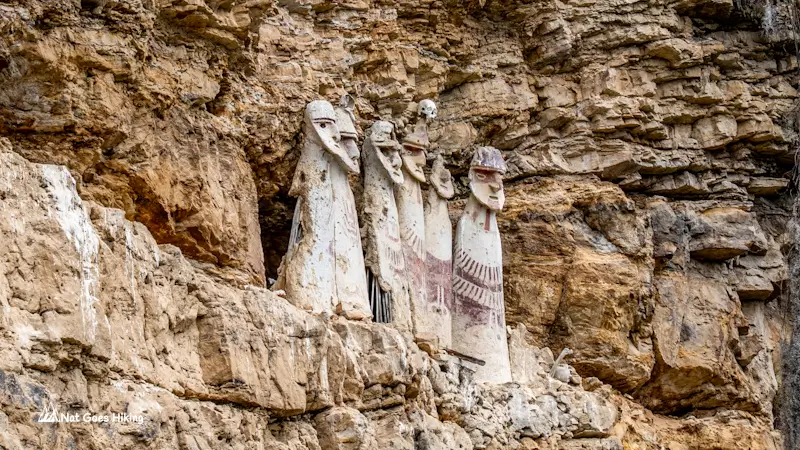
The Karajia Sarcophagi were built by the Chachapoya people around the 15th century to bury important members of their society. They are about 2.5 metres (8 ft) tall and shaped like human figures. Unlike stone tombs, they were made from a mix of clay, wood, and straw, then covered with white plaster and painted with distinctive facial features and geometric designs. Two of them have real human skulls placed on top.
Visiting Karajia felt completely different from exploring Peru’s famous Inca sites. It’s quieter, far less visited, and the setting is unforgettable.
Can You Visit Karajia Without a Tour?
Yes, absolutely. Karajia is one of the easier sites near Chachapoyas to do independently, mainly because there’s public transport available. You don’t need Spanish beyond the basics, you don’t need to book anything ahead, and you don’t need a guide to find the viewpoint; it’s a single obvious path from the plaza. The only real trade-off is that you won’t get the historical commentary a guide would give you, which I’ve tried to make up for later in this post.
We decided to visit without a tour, and below I will tell you how we did it using public transport.
How to Get to Karajia Sarcophagi from Chachapoyas
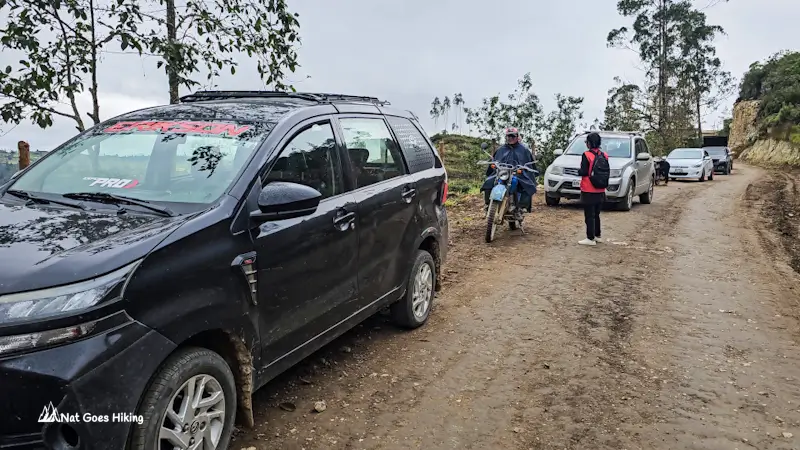
The Karajia Sarcophagi are located near the small village of Cruzpata in Luya Province, about 51 km from Chachapoyas. Although the distance isn’t far, allow around 2 to 3 hours to reach Cruzpata by public transport. When we visited, there was road work on the way from Luya to Cruzpata, so all the cars were stopped for about half an hour.
You can get to the Karajia Sarcophagi by:
- Public transport (the cheapest option)
- Taxi or private driver.
Getting to Karajia Sarcophagi by public transport
Start at the Terminal Terrestre in Chachapoyas and look for Luya Tours.
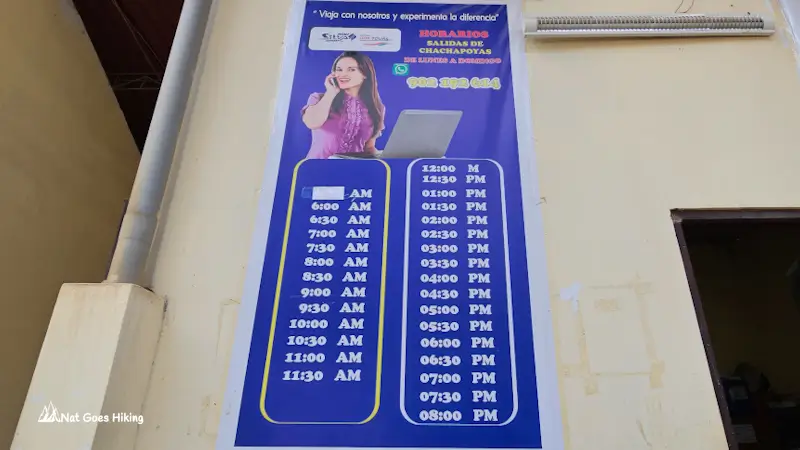
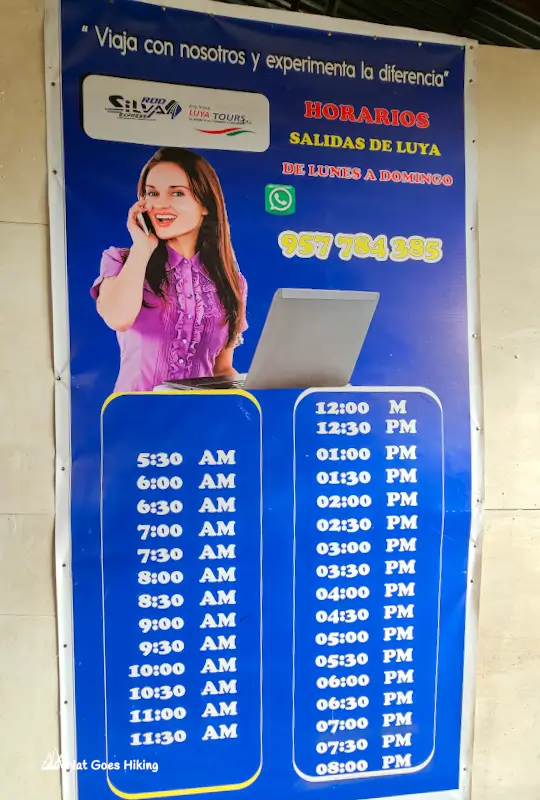
As of 2025, colectivos leave every 30 minutes from 6:00 am, with the first departure at 6:00 am. We turned up at 7.10 am, and our minivan left exactly at 7:30 am.
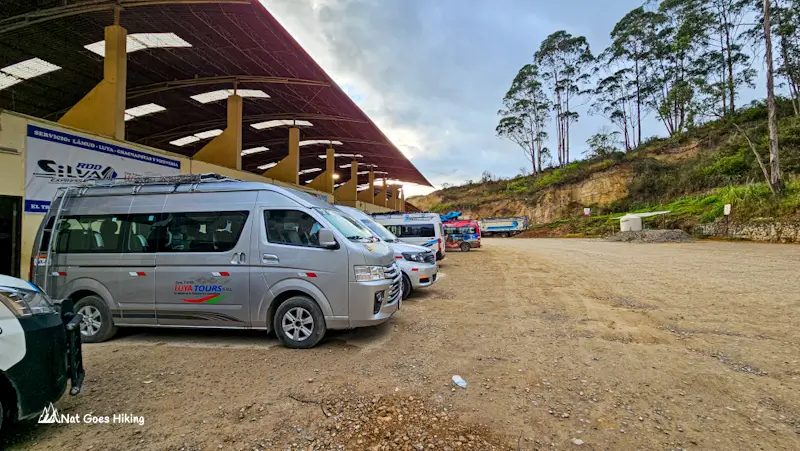
Cost was S/5 per person, and it took about 50 min to reach Luya.
At the Luya terminal, you switch to a smaller vehicle heading to Cruzpata, an SUV with extra seats squeezed into the boot. It looks like there’s no fixed timetable for this leg; you wait until it fills up, which took us about 30 minutes. The fare was S/10 per person. The road is unpaved, and the driver was moving fast for how rough it was.
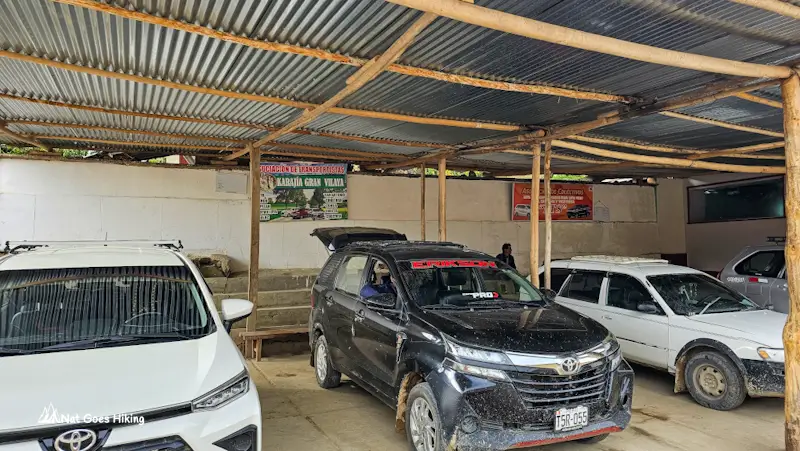
Our journey took about 1 hour 20 min, but only because we were delayed by roadworks for about half an hour. Under normal conditions, it takes around 40–50 min.
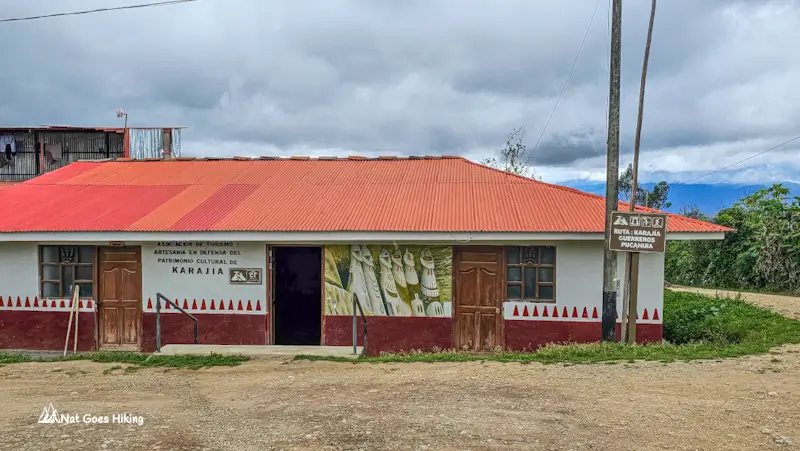
The colectivo drops passengers in the main plaza, where you’ll find the Karajia visitor centre.
Visiting Karajia by Taxi
Hiring a taxi or private driver from Chachapoyas is the easiest independent option if you’re travelling as a group. It gives you complete flexibility and lets you visit nearby attractions such as Quiocta Cave or Pueblo de los Muertos on the same day.
The easiest way to hire a private driver in Chachapoyas is through your hotel or a local tour agency. Most hotels can arrange full-day transport at short notice.
This option cuts out the transfer in Luya and gives you more control over timing. It costs more than going by public transport, obviously, but if there are two or three of you splitting it, the price gap narrows fast, and you save a good hour or two of waiting around at terminals.
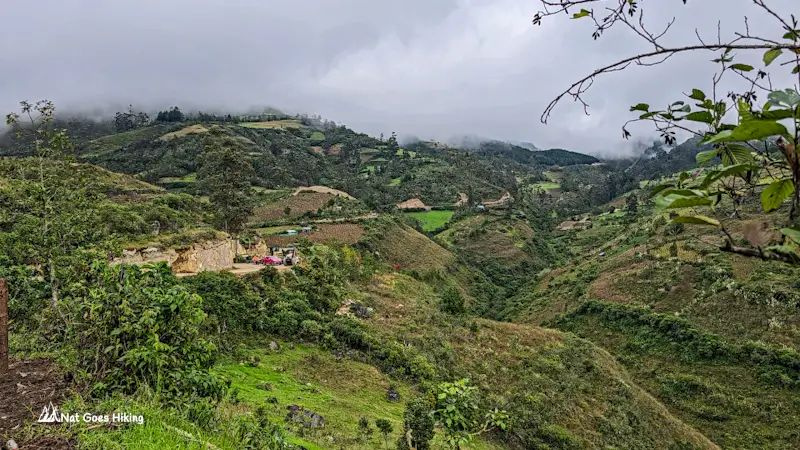
Karajia Sarcophagi: Tour vs Independent Visit
Visiting the Karajia Sarcophagi without a tour turned out much cheaper. We spent S/50 per person in total, including transport and the entrance fee. By comparison, in 2025, organised tours to Karajia and Quiocta Cave from Chachapoyas were selling for S/100-140 per person when I visited. Tours usually include transport, a guide, an entrance ticket, and lunch.
That said, tours still have their advantages. You won’t need to worry about changing transport, and about the return colectivo from Cruzpata, and your guide will explain the history and symbolism of the sarcophagi, something you won’t get if you visit on your own.
If you’re comfortable using local transport and enjoy travelling independently, I wouldn’t hesitate to recommend doing Karajia without a tour.
Karajia Tour vs Independent Visit
| Independent | Organised tour | |
|---|---|---|
| Cost | S/50 per person, incl. transport and entrance | S/100–140 per person |
| Transport | Two colectivos/ Transfer required | Included |
| Guide | No | Yes |
| Flexibility | High | Fixed itinerary |
| Includes Quiocta Cave | It’s easy to include if you hire a private taxi | Usually yes |
| Best for | Budget travellers and independent travellers | First time visitors, visitors short on time or wanting historical context |
Prices are based on our visit in July 2025 and may change over time. Transport costs are based on travelling from Chachapoyas by colectivos.
Karajia Sarcophagi Site: What to expect
Walk from Cruzpata to the Karajia Sarcofagi site
The colectivo dropped us at Cruzpata main plaza right in front of the Karajia visitor centre.
We paid the S/20 entrance fee (per person) and registered in the logbook. Although we arrived after 10 am, we were the first visitors of the day, which felt kind of nice. The visitor centre has a small collection of Chachapoya artefacts, photos, and information panels explaining the Chachapoya civilisation, as well as local handicrafts and souvenirs. There’s also a toilet, which costs S/1 or S/2 to use, as far as I remember.
Karajia Sarcofagi archaeological site is located to the east of Cruzpata main plaza. The lady at the visitor centre showed us the direction.
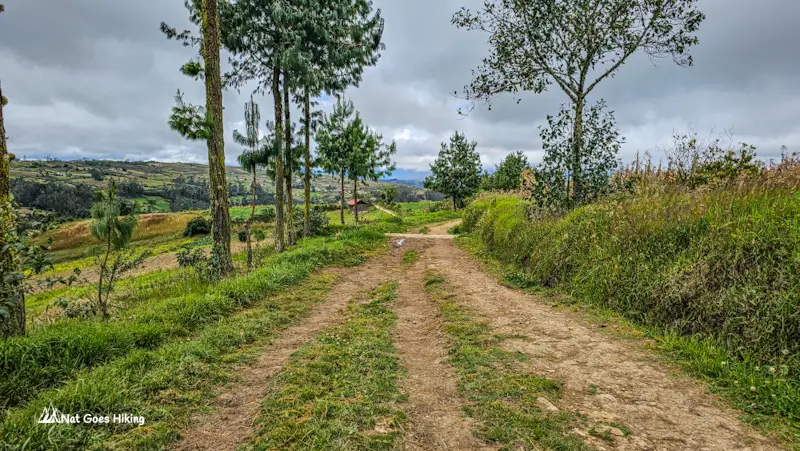
From the plaza, it’s about 1.5 km to the sarcophagi first viewpoint, and the whole thing is downhill with roughly 200 m (656 ft) of elevation loss. We walked it in around 20 minutes, but at a more relaxed pace, you’re looking at about 30 minutes. The path is well-defined and easy to follow. It’s partly stone-paved, so footing is generally fine.
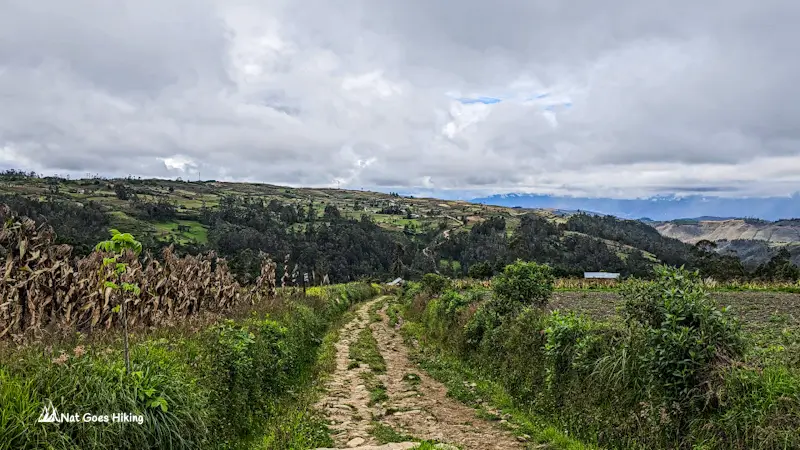
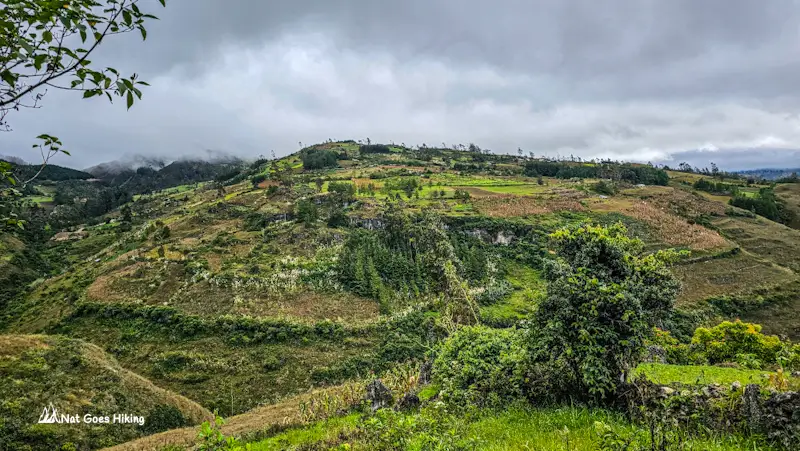
Don’t expect dense cloud forest or dramatic scenery along the walk itself. The path cuts through a quiet agricultural landscape with fields on both sides and the occasional grazing animal. For a while, it feels hard to believe you’re heading towards one of Peru’s most unusual archaeological sites.
At Karajia Sarcofagi Archaeological Site
Karajia’s first viewpoint
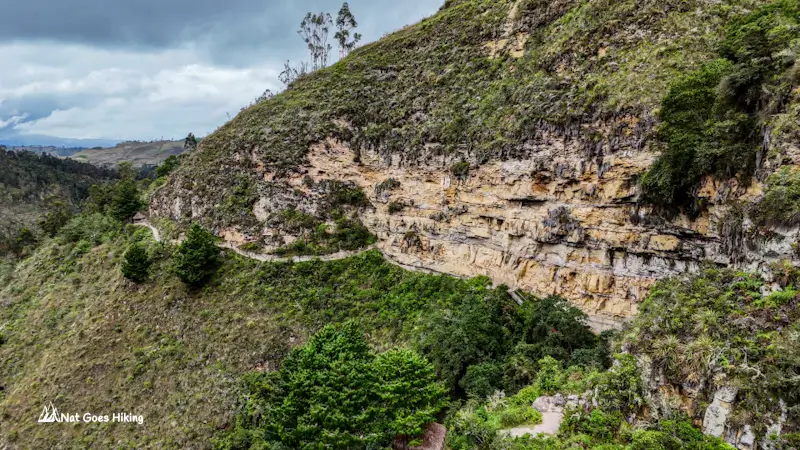
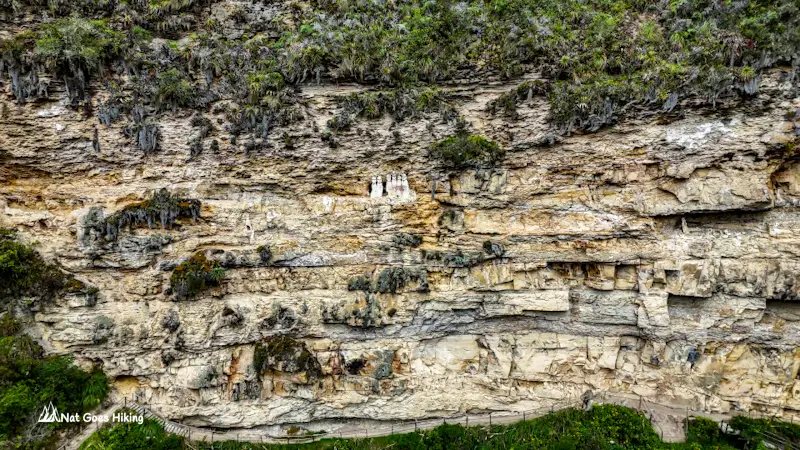
Right at the end of the trail, the path reaches the edge of a narrow gorge, and you reach the first viewpoint. High on a limestone cliff, you’ll see the six Karajia Sarcophagi standing on the tiny ledge.
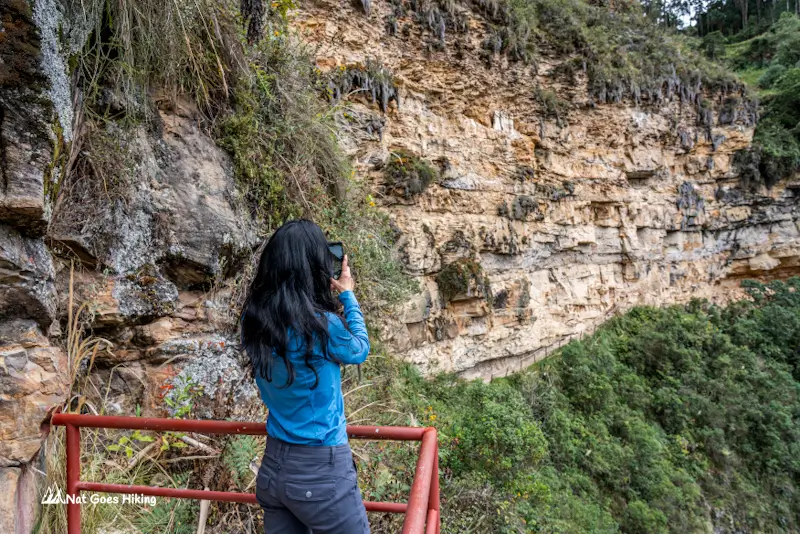
Each sarcophagus has a distinctive human-like face, and red geometric patterns are still visible on some of the figures. Two of the sarcophagi are topped with real human skulls, although one of the skulls is damaged.
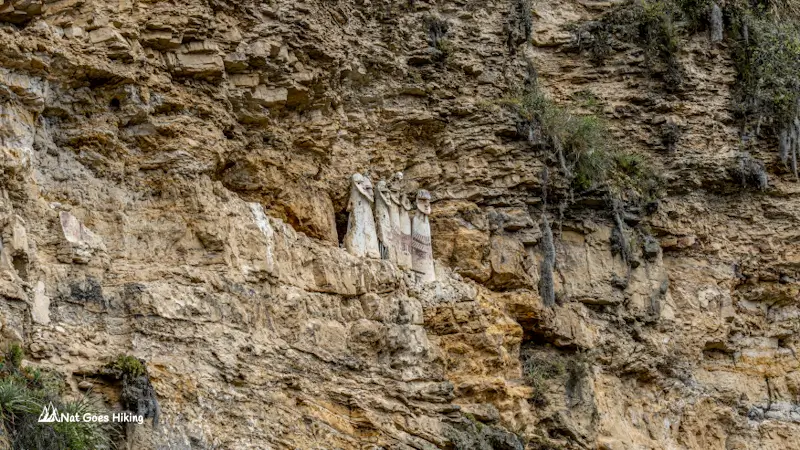
You won’t see the Karajia Sarcophagi up close. The viewpoint sits well below the cliff, so you are looking up at them from a distance rather than standing beside them. A camera with a good zoom lens or a pair of binoculars makes a big difference.
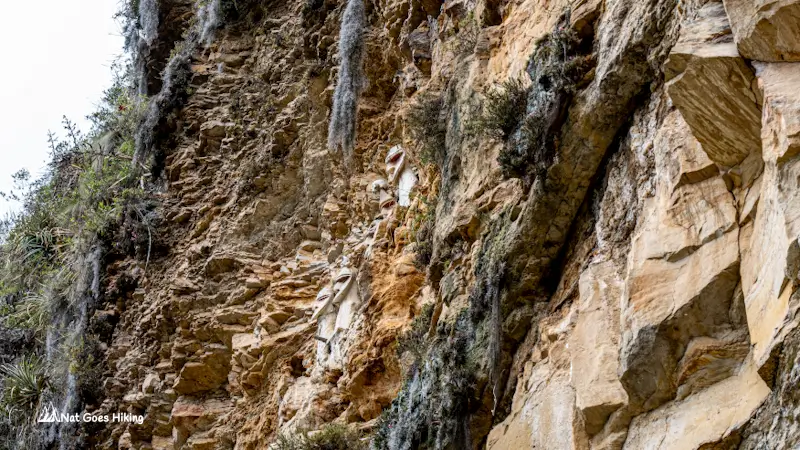
With some zoom, you can appreciate details that are difficult to see with the naked eye, including the white plaster coating, the wooden structure beneath the clay exterior, and the painted geometric designs.
Karajia’s second viewpoint
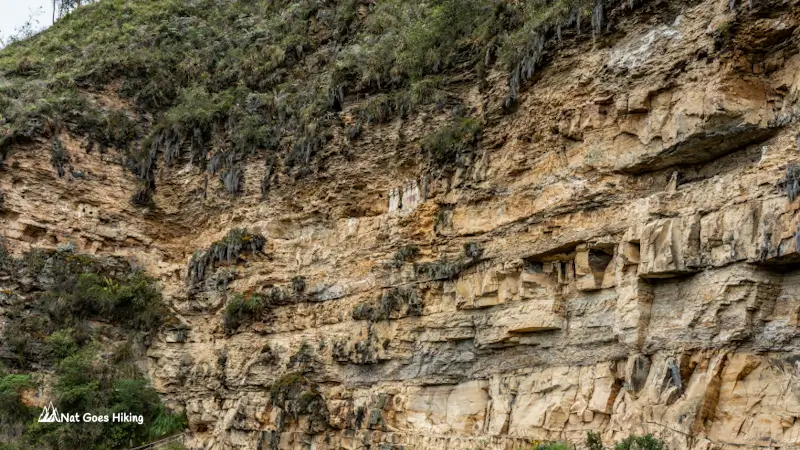
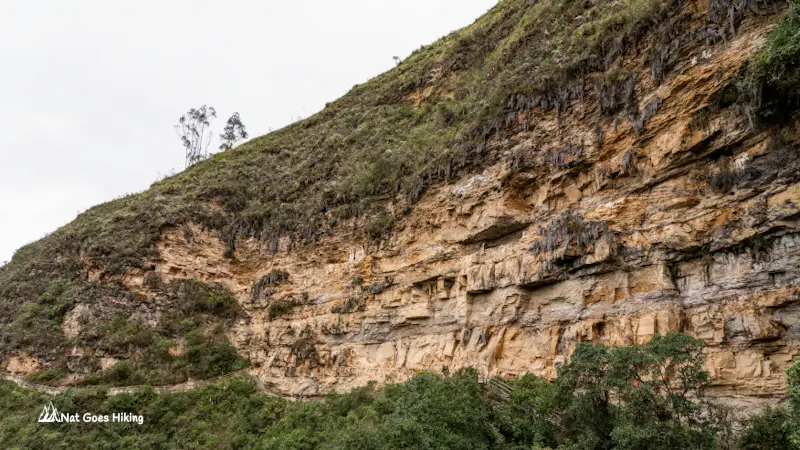
We went a little further along the path to a second viewpoint. The angle is slightly different, but from there we spotted another group of four or five smaller and less preserved sarcophagi to the left of the main six. They’re more weathered and much easier to miss. We almost walked back without seeing them because we didn’t even know they were there. Most photos online only show the main group of six.
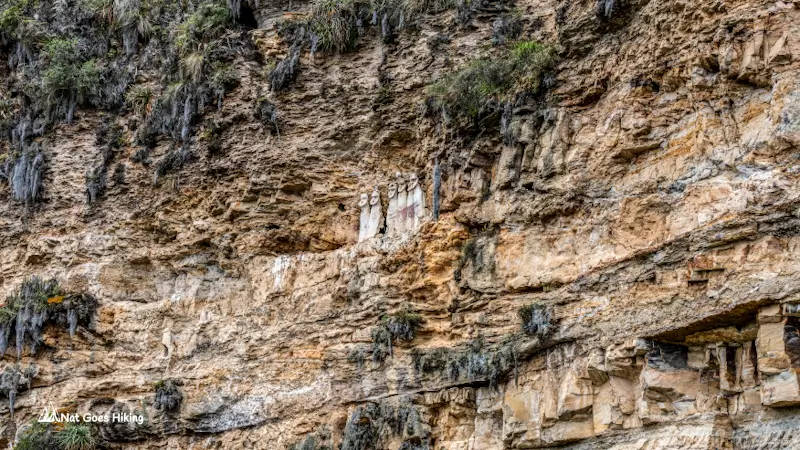
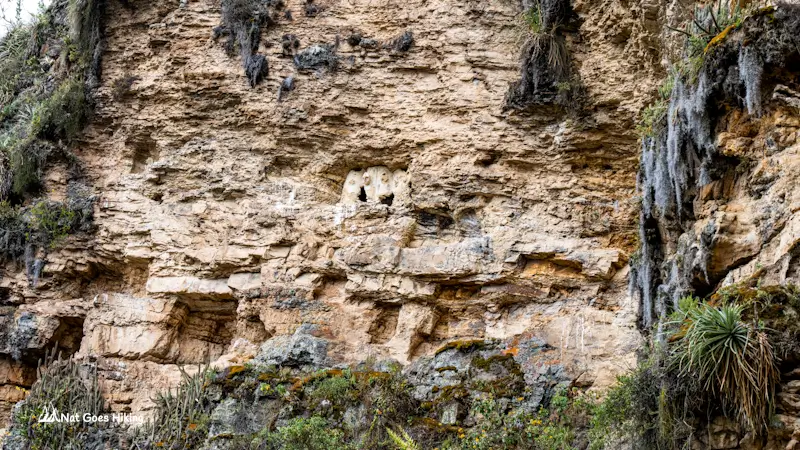
After returning home and looking through my photos, I noticed the remains of three more sarcophagi on the same cliff face.
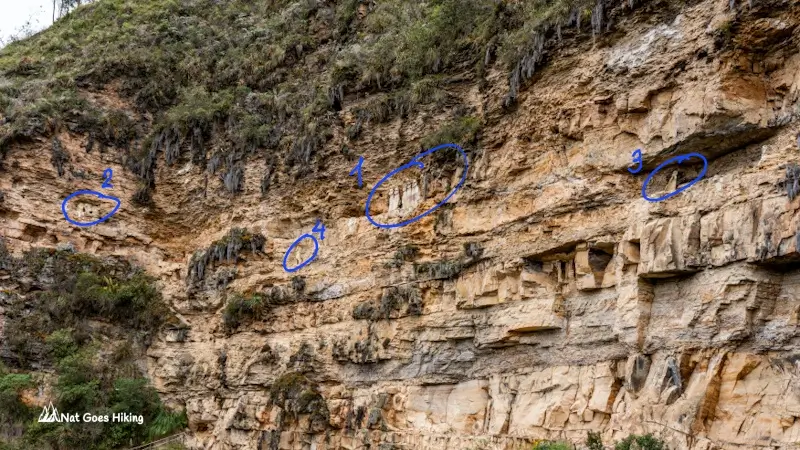
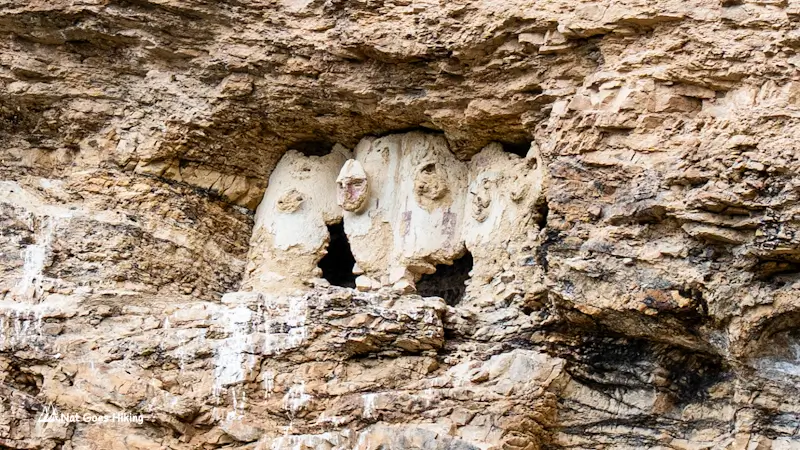
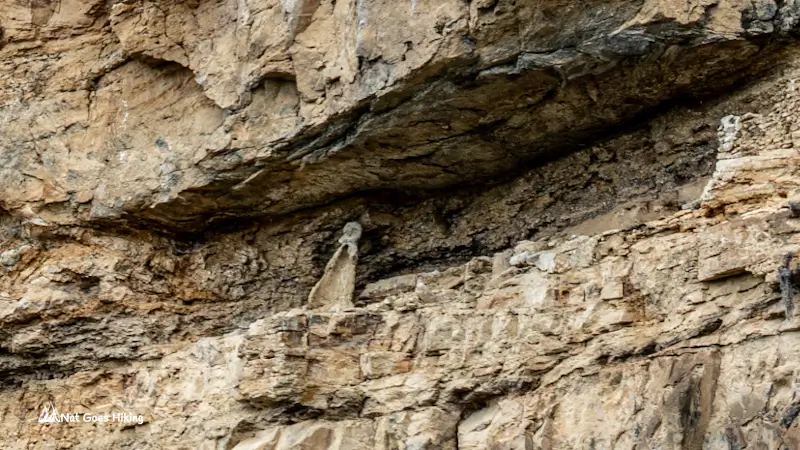
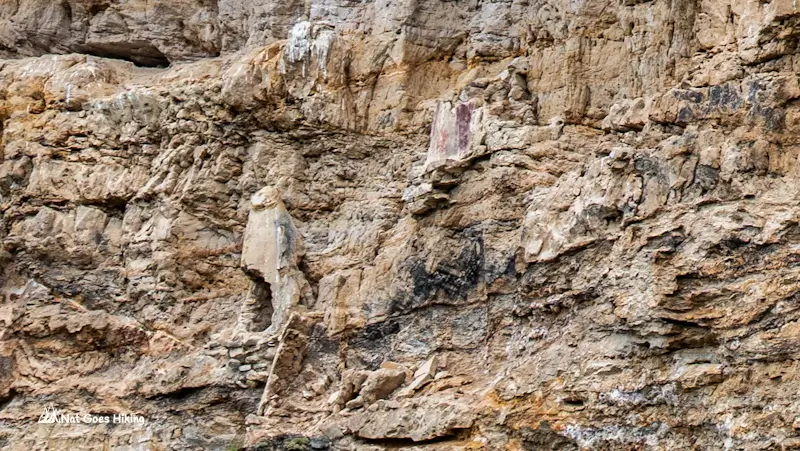
Watch out on the way to the second viewpoint, as the path passes below the limestone cliff where rockfalls can occur. Don’t linger there longer than necessary.
We ended up spending around 40 minutes at the site, taking our time to look at the details and simply enjoy the view. It was my first time seeing anything like this, and the experience was completely different from any other archaeological site I’d visited in Peru.
Walk back from the Karajia site to Cruzpata
Walking back to Cruzpata is the opposite of the way there. The trail is uphill, with around 200 m (656 ft) of elevation gain.
Surprisingly, it took us only 25 minutes to get back. We were walking faster than usual because we were worried that we might miss the last colectivo, which we thought left around midday. At a more relaxed pace, allow around 30 to 45 minutes for the return walk.
Return from Cruzpata to Chachapoyas
We returned to Cruzpata at around 11:40 am and were unsure how long we would need to wait for a colectivo. Colectivos from Cruzpata to Luya do not follow a fixed timetable. They usually leave once there are enough passengers.
We had an impression that we could get on a collective at the main plaza. I asked the lady at the visitor centre about the colectivo, and she kindly made a phone call for us. About 20 minutes later, the vehicle arrived.
From what I noticed, it seems that colectivos from Cruzpata are often arranged by phone rather than simply waiting at the plaza for passengers. After picking us up, the driver made a few stops around Cruzpata to collect other passengers from their homes. We had already started heading towards Luya when the driver received another call and turned back to pick up one more passenger.
From Luya, getting back to Chachapoyas is much more straightforward. When we visited, colectivos had a timetable and ran roughly every 30 minutes until the evening. Just remember that you need to buy your ticket inside the terminal before boarding, as colectivos stopping in Luya may already have passengers. The ticket seller can check seat availability when you buy your ticket.
About Karajia Sarcophagi
The Chachapoya Culture
The Karajia Sarcophagi were created by the Chachapoya people, a pre-Inca civilisation that lived in the cloud forests of northern Peru. They controlled this region for centuries before being conquered by the Inca Empire in the late 15th century.
The Chachapoya were known for their unique burial traditions, including placing important members of society in unusual locations such as cliffs and remote caves.
Unlike many other ancient cultures that buried their dead underground, the Chachapoya created human-shaped burial capsules and placed them in difficult-to-reach places. The Karajia Sarcophagi are one of the best surviving examples of this tradition.
Burial Tradition and Purpose
The Karajia Sarcophagi are not stone tombs. They are anthropomorphic burial capsules made from a mixture of clay, wood and straw, shaped to resemble the human form and designed to protect the mummified remains placed inside.
Archaeologists believe they were built for important members of Chachapoya society. The effort needed to create and place these tombs high on a cliff suggests that the people buried here held a special status within their communities.
How Old Are the Karajia Sarcophagi?
Radiocarbon dating places the Karajia Sarcophagi at around AD 1460, meaning they were created during the final period of the independent Chachapoya culture, shortly before the Inca conquest.
Standing in front of them today, it’s hard to believe they have survived for more than 500 years, exposed to the elements on the same cliff where they were originally placed.
Why Were the Karajia Sarcophagi Placed on a Cliff?
The location of the Karajia Sarcophagi was not chosen by accident. Perched high on a narrow limestone cliff, the tombs were extremely difficult to access. This helped protect them from looters and is one of the reasons they survived for centuries.
The location also likely had a spiritual meaning. The Chachapoya believed that placing their dead high above the valley brought them closer to the heavens and mountain deities. From their position overlooking the landscape below, the ancestors were also believed to continue watching over the living.
Karajia Sarcophagi discovery and research
The Karajia Sarcophagi were known by local communities long before they became famous internationally. They gained wider attention after Peruvian archaeologist Federico Kauffmann Doig led an expedition to the site in the mid-1980s.
His team had to climb around 24 metres of steep rock face to reach the tombs, showing just how inaccessible the location was. Kauffmann Doig later became one of the most important researchers of the Chachapoya culture, helping bring attention to the archaeological treasures of the Amazonas region.
Is Karajia Worth Visiting?
Yes, I think the Karajia Sarcophagi are worth visiting if you are already spending a few days in Chachapoyas, exploring other destinations in the area, and want to see something different from Peru’s better-known archaeological sites.
However, I honestly don’t think it is worth travelling all the way to Chachapoyas just to see Karajia. The site is relatively small compared with some of the region’s other attractions, and reaching it takes time and effort. To make the most of your trip, I would combine Karajia with other nearby places such as Gocta Waterfall, Kuelap Fortress, Revash Mausoleums, and Leymebamba Museum.
There are also a few things to know before you go. The sarcophagi are viewed from below the cliff, so you cannot walk right up to them. Getting to Karajia from Chachapoyas takes some planning, especially if you visit independently using local transport.
Best Time to Visit Karajia Sarcophagi
The best time to visit the Karajia Sarcophagi is during the dry season, from May to September. While the site can be visited all year, the unsealed roads and walking trail from Cruzpata are generally in better condition during the drier months, making the journey easier, especially if you are visiting without a tour.
We visited in July 2025, and the conditions were perfect for walking. The trail was dry, and getting there by public transport was straightforward.
If you visit during the rainy season, from November to May, allow extra travel time. Heavy rain can make the dirt roads muddy and occasionally slow transport, although the Karajia Sarcophagi remain open throughout the year.
What to Pack for Karajia Sarcophagi
You don’t need much to visit the Karajia Sarcophagi, but a few items will make the trip more enjoyable.
- Comfortable walking shoes. The walk from Cruzpata is about 1.5 km each way on a partly stone-paved path with an uphill return.
- Water. There’s a small shop next to the visitor centre where you can buy drinks and snacks before starting the walk, but it’s worth carrying a bottle with you.
- Sun protection: a hat, sunscreen and sunglasses are useful, as there’s no shade on the trail.
- A camera with a zoom lens or binoculars: bring one if you have it. It makes a huge difference, allowing you to clearly see the details of the sarcophagi, the painted decorations, and the human skulls on top of two of them.
- A light fleece might come in handy in the morning or if it gets windy.
- A light rain jacket: weather in the Chachapoyas region can change quickly, especially during the rainy season.
- Cash for the entrance fee, local transport, and any drinks or snacks you buy in Cruzpata.
- Tissues /toilet paper.
Other Places to Visit Nearby
If you’re visiting the Karajia Sarcophagi, I highly recommend combining them with some of the other incredible attractions around Chachapoyas. In my opinion, Karajia works best as part of a three or four -day itinerary rather than as a destination on its own.
Quiocta Cave: just a short drive from Cruzpata. It’s the easiest attraction to combine with Karajia, which is why most organised tours visit both on the same day. Easy to visit on the same day, if you have transport sorted. However, if you only rely on public transport, you might not have enough time to do it on the same day.
Pueblo de los Muertos is a lesser-known Chachapoya archaeological site hidden on a nearby cliff. It can also be combined with a visit to Karajia if you have your own transport or arrange a taxi for the day.
Gocta Waterfall is one of the tallest waterfalls in the world and one of the highlights of northern Peru. If you’re spending several days in Chachapoyas, I’d put this near the top of your list.
Kuelap Fortress is the largest and most impressive archaeological site in the Chachapoyas region and shouldn’t be missed if you have time.
Revash Mausoleums are colourful cliffside mausoleums built by the Chachapoya people. They are quite different from the Karajia Sarcophagi and offer another fascinating insight into Chachapoya burial traditions. If you go on an organised tour Revash Mausoleums and Museo de Leymebamba are usually combined into one tour.
Museo de Leymebamba is home to hundreds of remarkably well-preserved Chachapoya mummies and artefacts recovered from Laguna de los Cóndores. Visiting the museum gives valuable context before or after exploring the region’s archaeological sites.
Laguna de los Cóndores is a spectacular but remote mountain lake where hundreds of Chachapoya mummies were discovered. Reaching it requires a multi-day trek, making it one of the region’s more adventurous experiences.
Cañón del Sonche is one of the most scenic viewpoints near Chachapoyas, especially around sunset. It’s not far from Chachapoyas, and can be easily reached by public transport.
Karajia Sarcophagi FAQs
Yes, you can easily visit the Karajia Sarcophagi without a guide. We visited without a guide in July 2025 using local transport from Chachapoyas. The cheapest option is to take colectivos to Luya and then Cruzpata, followed by a short walk to the archaeological site.
We visited the Karajia Sarcophagi without a tour in July 2025 and spent S/50 per person in total, including S/30 for colectivos and S/20 entrance fee. That makes visiting the Karajia Sarcophagi independently much cheaper than joining an organised tour, which typically costs around S/100–140 per person and usually includes transport, a guide, a lunch and a visit to Quiocta Cave.
If you visit the Karajia Sarcophagi on an organised tour, it is usually a full-day trip from Chachapoyas, typically around 9:30 am to 6 pm, as tours usually combine Karajia with a visit to Quiocta Cave.
We visited the Karajia Sarcophagi without a tour and spent around 7.5 hours in total, from 7 am to 2:30 pm, using public transport. Around 40 minutes of that time was spent at the archaeological site itself. The rest was travelling and waiting for colectivos, which took around 20-30 minutes each time. We also lost extra time because of road works between Luya and Cruzpata.
The walk to the Karajia Sarcophagi is not difficult. From Cruzpata, it is around 1.5 km each way on a partly stone-paved path. The walk to the viewpoint is mostly downhill and takes around 20-40 minutes, depending on your pace.
The return walk is harder because it is uphill, with around 200 m of elevation gain, but it is still manageable for most travellers with a reasonable level of fitness.
The entrance fee to Karajia Sarcophagi is S/20 for adults.
Want more inspiration for travel in Peru? Check out these posts:
The Salkantay Trek is one of Peru’s best alternatives to the Inca Trail. In this guide, I break down each day on the trail, costs, difficulty, packing tips, and what it’s really like from my own experience hiking it.
Planning to visit Vinicunca Rainbow Mountain? Here’s how I avoided the crowds at Rainbow Mountain, plus tips on going independently from Cusco.
Looking for a quieter alternative to Vinicunca? Palccoyo offers multiple rainbow mountains, easier hiking, and far fewer crowds. Read my complete guide on how to visit without a tour.
Want more inspiration for travel in Peru? Discover Pallay Punchu, an off‑the‑beaten‑path alternative to Rainbow Mountain you can visit without a guide.
Seven colourful glacial lakes, views of Ausangate, alpacas roaming the valleys, and hot springs at the finish. We share our experience, costs, transport tips, and whether it’s worth doing without a tour.
Want to hike to Machu Picchu without a guide? Choquequirao Trek is a great alternative to the Inca Trail. Learn everything you need here.
Short on time for the full Huayhuash Circuit? This 4-day mini Huayhuash Trek without a guide still includes some of the trek’s most iconic views.
I hiked the Laguna 69 Hike in July 2025. Here’s what the photos don’t show: trail conditions, crowd levels, new 2026 access rules, costs, and more.
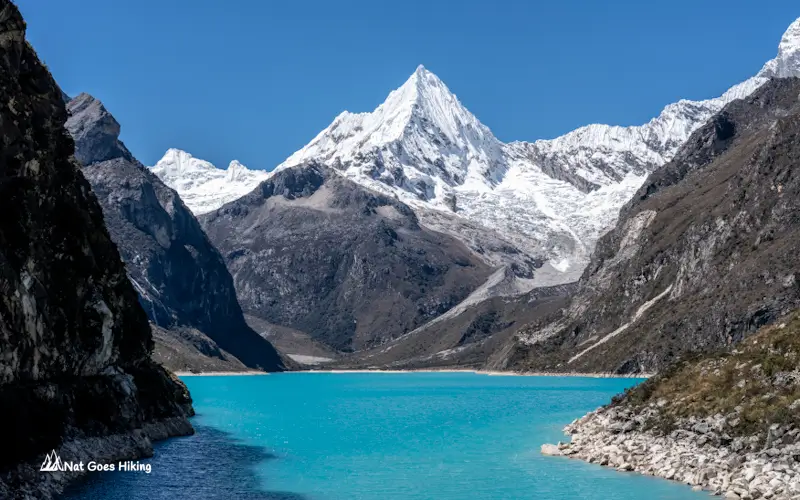
Planning hiking in Huaraz? Find the best day hikes and multi-day treks near Huaraz, including Laguna 69, Parón, Santa Cruz and Huayhuash with practical travel tips.
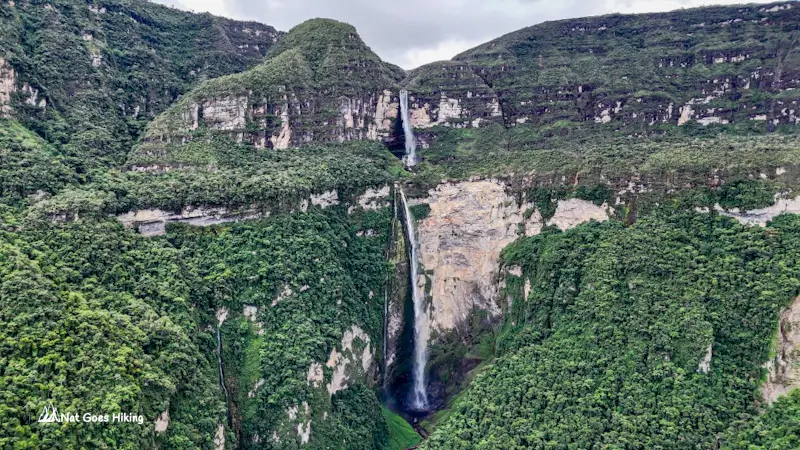
Planning the Gocta Waterfall hike? Learn about the trail, entrance fee, tour vs independent hike, costs, best time to visit and practical tips based on our July 2025 visit.