Kuelap is one of the largest archaeological sites in Peru, a stone fortress built by the Chachapoya on a ridge above the Utcubamba Valley, about 3,000 metres up. I found out Kuelap existed from a photo on the wall of our hotel in Lima. It showed a circular stone structure with a pointed conical straw roof and immediately caught my attention. It looked similar to the Instagram photo below. At that point, I’d never even heard of Kuelap, and had no idea anything like this existed in Peru, even though it was my second time in Peru. The only place I knew in northern Peru was Gocta Waterfall, and I wasn’t convinced it was worth travelling all that way just for a waterfall.
That photo completely changed my mind. There was something about that little round stone building that stuck with me. It looked mysterious and unlike anywhere else I’d seen in Peru. So we changed our plans and decided to head north to see it for ourselves. Keep reading to find out what it actually turned out to be.
Kuelap Fortress Overview
Kuelap Fortress: Quick Facts
- Location: Nuevo Tingo, Luya Province, Amazonas Region, northern Peru
- Distance from Chachapoyas to Nuevo Tingo: approx. 38km (about 1 h 15 min by colectivo)
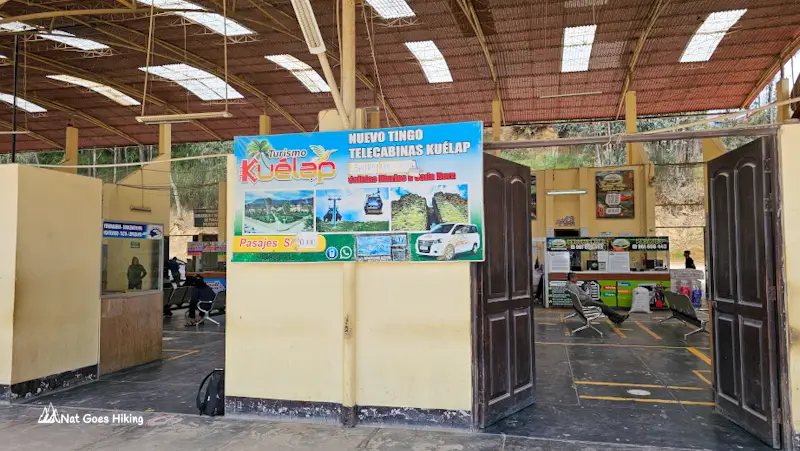
- Kuelap Cable Car (Teleférico de Kuélap): 20 min each way and return ticket S/26.5. Buy tickets at the cable car station.
- Last shuttle bus from La Malca cable car station: 4:00 pm
- Entrance fee: S/20 for Peruvians and Andean Community nationals; S/30 for foreign visitors. Tickets can only be booked online.
- Tickets: You’ll need two separate tickets: an entrance ticket (booked online through the Ministry of Culture) and a cable car ticket (purchased at the cable car station in Nuevo Tingo).
- Walk from La Malca cable car station to the fortress: ~1 km on a well-maintained, gently uphill path (20-40 min)
- Horses: Available between La Malca station and the fortress.
- Time needed: allow 4–6 hours from arriving at the cable car station in Nuevo Tingo
- Time needed inside the Kuelap Fortress: 1.5-2.5 hours
- Altitude: ~3,000 m
- Opening hours: Daily except Monday, 9 am to 5 pm
- Entry time slots: 9 am, 10 am, 11 am, 12 pm, 1 pm, 2 pm.
- Public toilets: Available at the Nuevo Tingo cable car station, the Kuelap visitor centre and near the fortress entrance.
- Best base town: Chachapoyas
- Drones: not permitted
To visit Kuelap, 2 types of tickets are required: entrance tickets which is booked online on Ministry of Culture website and cable car ticket which you can buy on the spot at the cable car station in Nuevo Tingo.

Kuelap is often called the Machu Picchu of the North. I’ll be honest, that comparison doesn’t really hold up, and I’ll get into why further down. Today, getting there is surprisingly easy thanks to the Kuelap cable car, which has been operating since 2017.
Kuelap was built between AD 900 and 1100, long before the Inca came to this part of Peru. On paper, Kuelap sounds enormous. Around 400 circular stone structures, huge defensive walls, and one of Peru’s biggest archaeological sites. But standing there, it didn’t actually feel that big to me. Maybe it’s because so many of the buildings are now just low circular stone walls. It felt very different from what I’d imagined after seeing that photo in Lima.

How to Get to Kuelap from Chachapoyas
Visiting Kuelap without a tour
This is a summary of how to visit Kuelap Fortress without tour.
- Buy Kuelap tickets online
Kuelap tickets can only be booked online on the Ministry of Culture website.
- Take colectivo from Chachapoyas Terminal Terrestre to Nuevo Tingo
Colectivos go all the way to the Kuelap cable car. Duration: ~1 h 15 min. Cost: S/10.
- Buy a cable car ticket at the cable car station
Cost: S/26.5 (cash).
- Board a shuttle bus going to the cable car platform.
Buses run every 10 min. The ride takes 10 min.
- Board the cable car
The cable car ride takes 20 min.
- Walk from the cable car station to Kuelap Fortress
Well-maintained path with a gentle uphill. Distance: ~1 km. Time: 20-40 min.
- Enter Kuelap Fortress and follow the official circuit.
Step 1. Getting from Chachapoyas to Nuevo Tingo
To visit Kuelap, you first need to get to the small town of Nuevo Tingo. This is where you’ll catch the Kuelap cable car (teleférico), which takes you up the mountain towards the archaeological site.
Getting to Nuevo Tingo is straightforward. Just take a colectivo from the Terminal Terrestre in Chachapoyas, about a 15-minute walk (1 km) from the town centre.
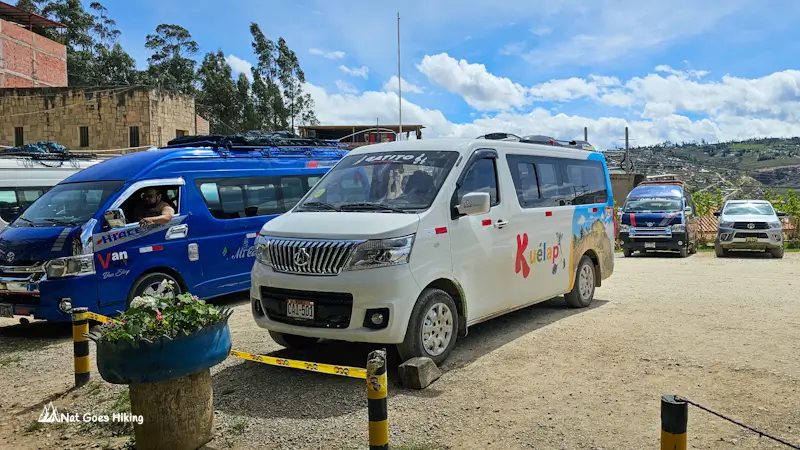
We decided to stay overnight in Nuevo Tingo, so we headed to the terminal in the afternoon. When we arrived, finding the right colectivo was easy. One of the minivans had a big, colourful “Kuélap” sign on the side, so we knew we were in the right place. The 38 km ride to Nuevo Tingo took us around 1 hour 15 minutes. We paid S/10 ($2.95) each.
The ride from Chachapoyas to Nuevo Tingo was very scenic. The road (B8) follows the Utcubamba River through a beautiful canyon, with lush mountains and dramatic cliffs on either side. It definitely made our journey feel like part of the adventure rather than just a transfer.
Once you get to Nuevo Tingo, don’t get off in the town if you’re visiting Kuelap the same day. Colectivo can get all the way to the Kuelap cable car station (Teleférico de Kuélap).
Step 2. Kuelap cable car: getting from Nuevo Tingo to Kuelap
We came to the cable car station the following morning, just before 8 am. Here we bought cable car tickets, which were S/26.5 ($7.8) per person if you pay cash. There is a 3.05% surcharge if you pay by card, and only national cards are accepted. Don’t forget to bring your passport, as you need to present it when you buy tickets.
After buying tickets, we had to wait for about 10 min to board a bus that took us to the cable car boarding platform. The first bus departs at 8 am and runs every 10 minutes. The last return bus is at 4 pm. The distance to the platform is 3 km and takes 10 min. Please note that the last return bus is at 4 pm.

The cable car ride is about 20 min. Over these 20 min we covered a distance of 4 km, crossed a large canyon and ascended 658 m, from 2,272 m to 2,930 m.
One cable car cabin can take 8 people, but we were the only ones in the cabin. The ride itself was impressive. But I think it took a chunk of the adventure out of getting there. Before the cable car existed, many people would hike up through the cloud forest to reach the Kuelap fortress. Now you get into a cabin and arrive at the top in twenty minutes. It’s efficient, but it just has a slightly commercialised feel to it that reminded me of some scenic attractions I’d visited in China.
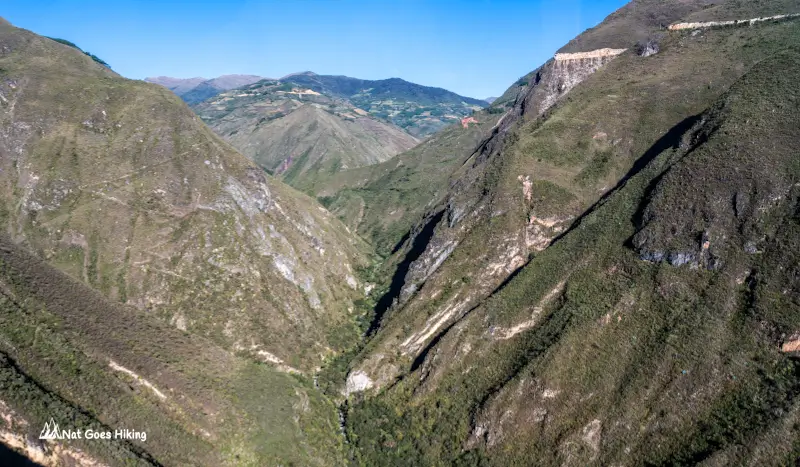
The views on the way up are decent, but the landscape looked more brownish-grey than the lush green I had in my head. Might’ve just been the dry season. Either way, it wasn’t the cloud forest I was picturing.
Before the cable car opened in 2017, people reached Kuélap via an unsealed mountain road from Nuevo Tingo (~2 hours), or by hiking the traditional trail.
Cable car maintenance
If you’re planning to visit Kuelap in May, check the official Telecabinas de Kuélap website before you go. The cable car usually shuts down for its annual maintenance around this time, although the dates change from year to year. The archaeological site normally stays open, but you’ll need to use an alternative access route while the cable car isn’t running.
At Kuelap Fortress: What to Expect
Walking up to Kuelap
The cable car brings you to La Malca station. This is where the visitor centre is. If you would like to hire a guide, you can enquire at the visitor centre.
From there, you need to walk up to get to the Kuelap archaeological complex itself. It’s about 1 km, and it took us about 20 min. If you don’t want to walk, you can hire a horse.
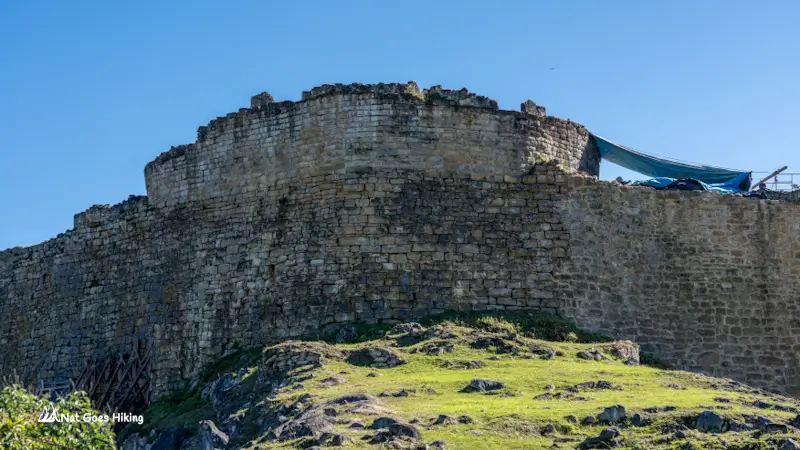
When we approached the fortress, the first thing we saw was a tall fortress wall. It became evident that Kuelap was under restoration: there was scaffolding and plastic material covering parts of the fortress wall. The southern wall of Kuelap collapsed in 2022 after heavy rain.
Official visitor circuit
So what happens once you enter Kuelap? When visiting Kuelap, you have to follow the official circuit. You can refer to this map of the Kuelap circuit from the Ministry of Culture.
Kuelap has three entrances. The west entrance is closed to the public. At the time we visited in July 2025, the other two on the eastern side were in use. However, as of 2026, entrance and exit are only possible through the Service Entrance (Entrada de Servicio).
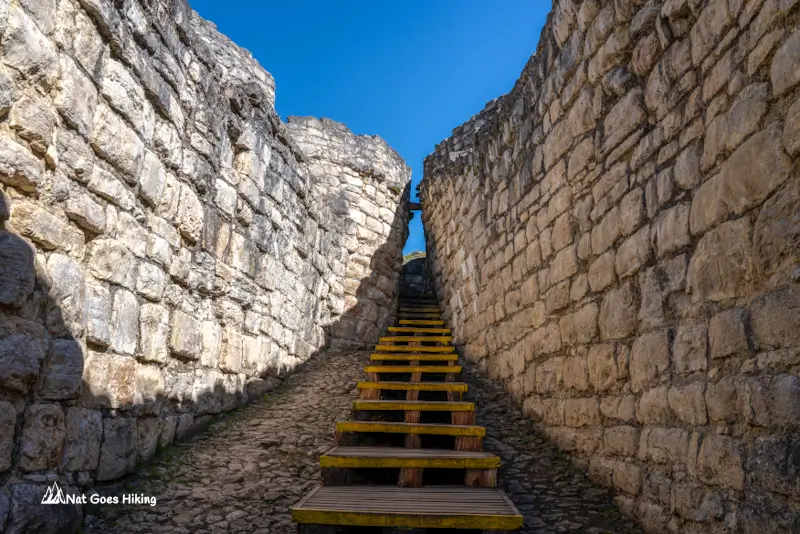
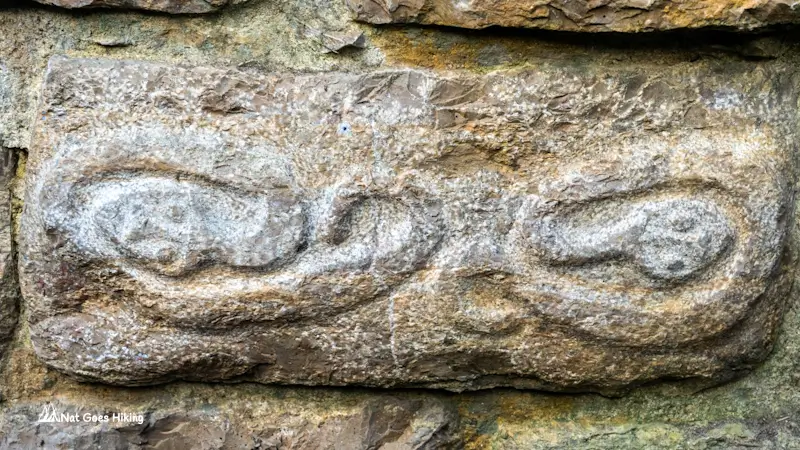
We entered through the Main Entrance (Entrada Principal) on the eastern side of Kuelap. As you go through the narrow passage, you will notice high-relief carvings, one of which shows a bird-monkey hybrid; the beak and legs appear to belong to a bird, maybe to a condor, while the tail to a monkey. Another stone shows two serpents, and a few other stones have worn human faces.

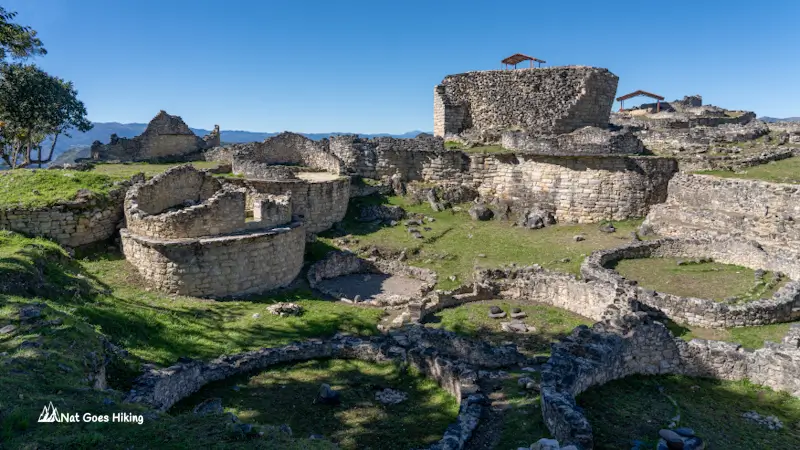
Once you enter the fortress, you find yourself surrounded by circular-shaped ruins packed quite close together. Some of the largest ones have beautiful zigzag and diamond-shaped friezes.

Following the official circuit, you’ll reach the Main Temple (Templo Mayor), one of the most unusual structures at Kuelap. Its inverted truncated cone shape is why it is often compared to an inkwell and known as El Tintero.

From the outside, there is no visible entrance or opening, so it looks like a solid stone structure. Archaeologists discovered that it actually contains a deep bottle-shaped chamber, where ceremonial offerings and human and animal remains were found. You can’t see the chamber during your visit, but the visitor centre has information about this strange structure.
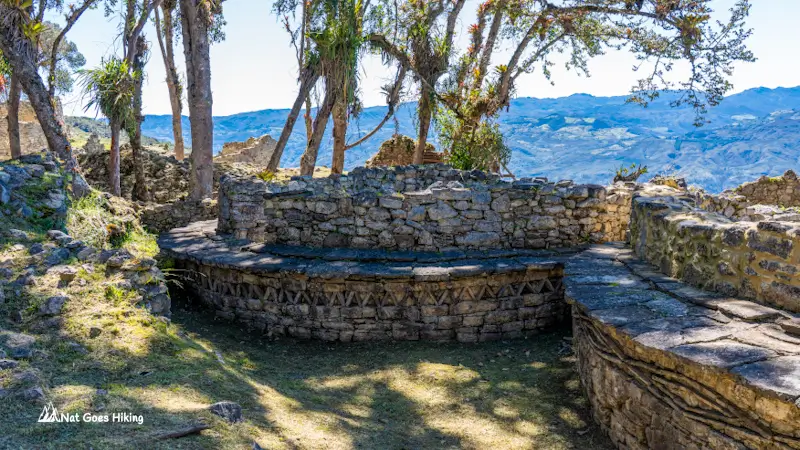
We continued along the official circuit. The site has remains of about 400 circular houses, so they were everywhere. It took us 1.5 hours to complete the circuit. I think if you go with a guide, it would take longer. We exited through the Service Entrance (Entrada de Servicio), which is not the only one used as an entrance and exit due to restoration works.

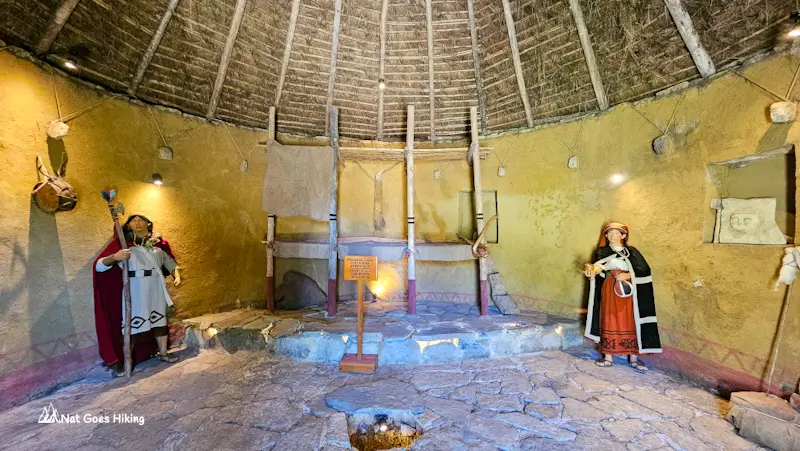
On your way back to the visitor centre, you’ll pass by the Kuelap house replica. It’s a full-scale reconstruction of the round houses, with a thatched roof and the interior of a house. Good one to finish on.

How busy is Kuelap?
It wasn’t busy when we went, but I wouldn’t call it a lonely, forgotten ruin either, which is how some reviews make it sound. We arrived at 9am on a Sunday, the first entry slot of the day, and had long stretches where it felt like we had whole sections to ourselves.
Worth noting though, Kuélap gets a fair bit of domestic tourism, especially on weekends and holidays. We didn’t spot a single other international visitor the whole time we were there. On the walk back down, there were quite a few people still heading up, and the visitor centre itself was properly busy by then. If you want that empty-ruins feeling, aim for a weekday and get there for the first time slot available, which is 9 am. When we booked our tickets, the 10 am and 11 am slots appeared to fill up first. Weekends and Peruvian holidays are when the local crowds show up.

Kuelap Entrance Tickets
Here’s what you actually need to know before visiting Kuelap. You can’t buy a Kuelap entrance ticket at the gate. The tickets are sold online only, through the Ministry of Culture page tuboleto.cultura.pe.
When buying tickets, you need to choose a circuit. There are two options: 1. Complejo Arqueológico Monumental Kuélap + Circuito Cultural de la llacta de Kuélap, and 2. Complejo Arqueológico Monumental Kuélap sin incluir Circuito Cultural de la llacta de Kuélap. Option 1 is the one you need. Option 2 is free, but you won’t be able to enter the Kuelap fortress itself; it only gives access to the visitor centre at Malcapampa, the interpretation centre, the trails, and the Chachapoya house replica.
The ticket for Option 1, the full circuit giving access inside the walled city of Kuelap, costs S/30 ($8.8) for foreigners and S/20 ($5.9) for Peruvians and Andean Community nationals. Students and children get a discount. On the first Sunday of each month, Peruvians receive free entry.
Kuelap is open Tuesday to Sunday, 9 am to 5 pm; on Mondays, it is closed for maintenance. So plan your visit accordingly.
Cable car tickets are sold separately. You can buy them on the spot at the cable car station at Nuevo Tingo. The price is S/26.5.

Tour vs independent visit cost comparison
Kuelap Visit Cost Comparison: Independent vs Tour
| Expense | Independent | Tour from Chachapoyas |
|---|---|---|
| Transportation | Colectivo between Chachapoyas and Nuevo Tingo: S/20 (S/10 x 2) | Included |
| Cable car | S/26.5 | Included |
| Entrance fee | S/30 | Included |
| Guide | Extra | Included |
| Lunch | S/10 in Nuevo Tingo | Included |
| Total | S/86.5 ($25.4) | S/100 – 120 ($29.4 – $35.3) depending on agency |
Visiting Kuélap independently isn’t necessarily cheaper than joining a tour. Once you add transport, the cable car, entrance fee, and lunch, you’ll spend around S/86.5. When we enquired about tour prices in Chachapoyas in 2025, day tours cost S/100 – 120, depending on the tour agency, and those prices included transport, entrance fees, the cable car, lunch, and a guide.
You’re paying slightly more, but for convenience and, importantly, the insight a guide adds. Kuelap’s history isn’t well signposted on site, so if you want context on what you’re actually looking at, having a guide is an advantage. You can hire a guide on arrival at Kuelap if you come independently, but still want a guide.

Is Kuelap Worth Visiting?
Yes, but depends on what else is on your itinerary and if you have the right expectations.
If Kuelap is the only reason you’re travelling to Chachapoyas, I don’t think it’s worth making the trip just for that. But if you’re already planning to visit at least one other place, such as Gocta Waterfall, the Karajia Sarcophagi, or the Revash Mausoleums, then I’d definitely include Kuelap Fortress in your itinerary. That’s exactly what we did.
I’ll admit I was a bit disappointed, but only because my expectations were completely different. I saw a photo on the wall of a hotel in Lima, which caught my attention. It showed a circular stone structure with a pointed conical straw roof. That was how I found out about Kuelap. These kinds of photos, as well as dramatic drone shots from above, are used by many tour companies to promote Kuelap.

The reality is different. That circular house with a straw roof you see in the older photos doesn’t exist anymore. I asked the agency we booked our Gocta waterfall tour with about these roofs, and their reply was that the roofs were removed due to safety and because there’s no evidence they looked that way. Drones are also prohibited at Kuelap, and there isn’t a viewpoint where you’ll get those spectacular aerial views. In other words, some of the most eye-catching promotional photos simply aren’t what you’ll experience during a visit.
Also, Kuelap is promoted as the “Machu Picchu of the North.” After visiting, I’ll be honest, I don’t think that comparison really holds up. If you’re expecting something with the same scale, atmosphere, or wow factor as Machu Picchu, there’s a good chance you’ll leave feeling disappointed.
That doesn’t mean Kuelap isn’t worth seeing. It just means it’s better to visit for what it really is: one of Peru’s most important Chachapoya archaeological sites, not another Machu Picchu. We actually enjoyed having a relaxed day exploring the ruins between demanding multi-day hikes and freezing nights in a tent. Looking back, I’m glad we went.

Best Time to Visit
The best time to visit Kuelap depends on what you’re looking for.
If your priority is good weather and the highest chance of a smooth trip, visit during the dry season from May to September. This is generally the best time to visit Kuelap. You’ll usually get clearer skies, less rain, and better road conditions, making it easier to explore the fortress and the rest of the Chachapoyas region.
We visited Kuelap in July, right in the middle of the dry season. The weather couldn’t have been better. It was sunny, dry, and pleasantly cool, perfect for wandering around the ruins without worrying about rain.
But there are also some drawbacks. When we took the cable car, the canyon looked quite dry and brownish. Many of the Kuelap cable car photos show the lush green slopes with some mist sitting on them. The morning sun was already quite bright too, creating fairly harsh light for photography.

Looking back, I think photographers might actually prefer the shoulder seasons, around April or October. Kuelap sits where the Andes meet the Amazon, so these months often bring low cloud and mist without the constant heavy rain of the wet season. Those moody photos showing clouds drifting around the surrounding mountains are much closer to what I’d hoped to see. Of course, the weather is unpredictable, so there’s no guarantee you’ll get those conditions.
The rainy season, usually from November to March, transforms the landscape into a much greener place. If you’re lucky, the fortress can look incredibly atmospheric with mist rolling through the valleys and soft light over the ruins. The downside is that you’re much more likely to encounter rain, low visibility, and travel disruptions. Heavy rainfall has also affected Kuelap in recent years, e.g., in 2022, one of the walls collapsed after heavy rain.
If I visited Kuelap again, I’d probably choose April or October. I’d happily trade the guaranteed blue skies we had in July for a chance of seeing the fortress surrounded by cloud and greener hills. For most travellers, though, especially if you’re visiting Kuelap without a tour or have limited time, the dry season is still the safest and most reliable choice.
What to Pack for Kuelap
Comfortable walking shoes: Kuelap isn’t a proper hike, but don’t underestimate how much you’ll walk. Between the cable car station, the archaeological site and wandering around the ruins, I clocked just over 9,500 steps during our visit.
Water: Bring a bottle of water, especially on a sunny day. You can also buy drinks at the café near the Kuelap cable car station and at the visitor centre.
Sun protection: Much of the site is exposed, so pack a hat, sunscreen, and sunglasses. Even when we visited in the morning, the sun was surprisingly strong.
A light jacket: Although Nuevo Tingo is much lower, Kuelap sits at around 3,000 metres, so it can feel noticeably cooler once you get to the fortress.
A lightweight rain jacket: Weather in the Amazonas region can change quickly. Even during the dry season, it’s worth having one in your daypack.
Passport (or DNI for Peruvian citizens): You’ll need to show it when buying your Kuelap cable car tickets and again when entering the archaeological site.
Cash: Bring cash for colectivos, meals, drinks, and accommodation if you’re staying overnight in Nuevo Tingo. When we visited, paying for the cable car by card incurred a 3.05% surcharge, so we paid by cash.
Tissues or toilet paper: Public toilets don’t always have toilet paper, so it’s worth carrying a small packet with you.
About Kuelap History
The Chachapoya and Kuelap
Kuelap was built by the Chachapoya, the same “Warriors of the Clouds” people behind the Karajia Sarcophagi, though Kuelap is centuries older than Karajia. People were living on this site as far back as the 5th century AD, and most of the stone walls and structures you see today went up between AD 900 and 1100.
Kuelap’s outer walls reach 20 metres in places, taller than most Inca constructions. It looks like the site was built with defence in mind. Narrow entrance corridors would’ve made it easy to control who came and went.
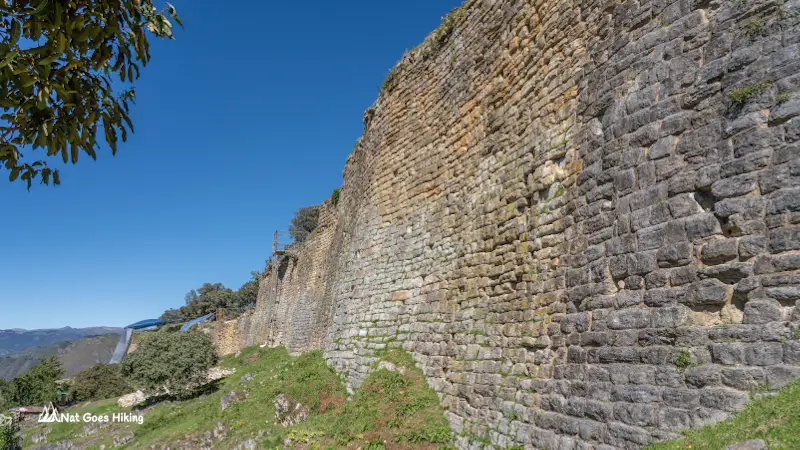
The Inca conquered the Chachapoya region in the 1470s, and Kuelap’s population thinned out further once the Spanish arrived not long after. The site sat largely forgotten outside the local area until a Peruvian judge wrote about it for the wider world in 1843. Local communities, of course, had always known it was there.
Other Places to Visit Nearby
If you’re based in Chachapoyas, Kuelap combines well with the rest of the region:
Revash Mausoleums and Leymebamba Museum: Chachapoya burial sites and artefacts, usually combined into one day trip.
Karajia Sarcophagi, cliffside Chachapoya tombs, easy to visit independently.
Gocta Waterfall, one of the tallest waterfalls in the world, also doable on your own.
Laguna de los Cóndores is a spectacular but remote mountain lake where hundreds of Chachapoya mummies were discovered. To get there you need to do a multi-day trek, so it’s a more adventurous experience.
Cañón del Sonche is one of the most scenic viewpoints near Chachapoyas. It’s not far from Chachapoyas, and can be easily reached by public transport.
Kuelap FAQs
Yes. Visiting Kuelap without a tour is straightforward, and that’s exactly how we did it. Simply take a colectivo from Chachapoyas to Nuevo Tingo, ride the Kuelap cable car (Teleférico de Kuélap), then walk to the archaeological site. You don’t need to hire a guide, although guides are available at the entrance if you’d like to learn more about the history.
We spent S/86.5 per person in July 2025, incl. colectivo between Chachapoyas and Nuevo Tingo, both ways S/20, cable car return ticket S/26.5, Kuelap entrance fee S/30 and lunch in Nuevo Tingo S/10.
Kuelap Fortress sits on a mountain ridge near the small town of Nuevo Tingo, in the Luya Province of Peru’s Amazonas region, in northern Peru. The closest larger town with an airport is Chachapoyas.
Most travellers fly to Chachapoyas, which has the closest airport to Kuelap. However, flights are limited and can be affected by weather. Many visitors instead fly to Jaén and continue by road to Chachapoyas (3–4 hours) before visiting Kuelap, since it’s the more reliable route year-round.
The Kuelap cable car costs S/26.5 ($7.8) for a return ticket. Bring cash, as only national cards are accepted, and they incur a surcharge of 3.05%.
The entrance fee for foreigners (adults) is S/30 ($8.8) and S/20 ($5.9) for Peruvians and Andean Community nationals.
Visiting Kuelap from Chachapoyas is a full-day trip (7-8 hours). Plan to spend around 1.5 hours at the archaeological site if you’re exploring on your own, or up to 2.5 hours if you’re joining a guided tour. On top of that, allow about 1 hour 15 min each way for the colectivo between Chachapoyas and Nuevo Tingo, 20 min for the Kuelap cable car, a 10-min shuttle bus to the boarding station, and around 20-40 min to walk from La Malca station to the fortress, plus waiting time for the colectivo and shuttle bus.
No. The walk from the upper Kuelap cable car station (La Malca) to the fortress follows a well-maintained 1 km path with a gentle uphill climb. Most visitors shouldn’t have any trouble reaching the entrance. If you have limited mobility or simply don’t feel like walking uphill, horses are available for hire.
Kuelap sits at an altitude of approximately 3,000 m (9,843 ft) above sea level.