We were heading to Cajamarca, and since we were travelling overland, Trujillo was a natural point to break up the trip. Once there, the main destination to visit was Chan Chan. When I started looking into what else to see around Trujillo, I came across Huaca de la Luna and Huaca del Sol, another major archaeological site just outside the city. They were built by the Moche civilisation, long before the Incas.
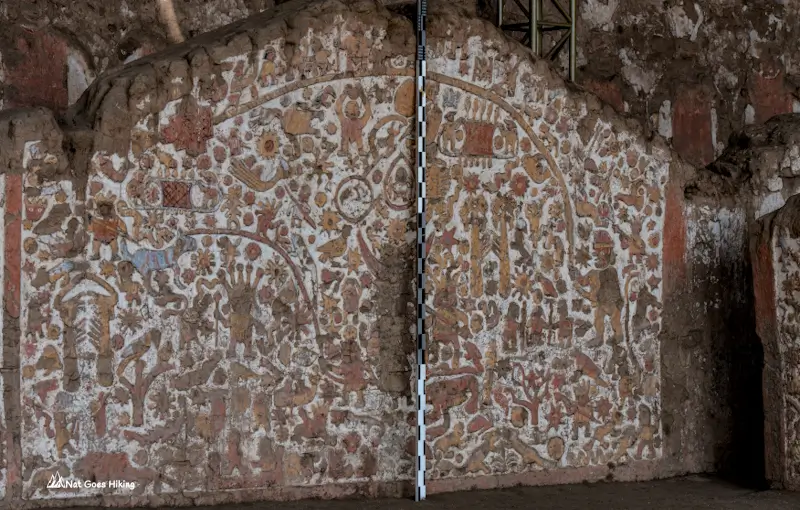
We decided to visit, and it ended up being quite different from Chan Chan. The real highlight for me was seeing the coloured murals and reliefs on the walls. You can get very close to parts of the ancient huaca, and it makes the site feel very different from the huge open spaces of Chan Chan.
If you’re planning a trip to Trujillo, here’s what you need to know about visiting Huaca de la Luna and seeing Huaca del Sol.
Huaca de la Luna and Huaca del Sol: quick facts
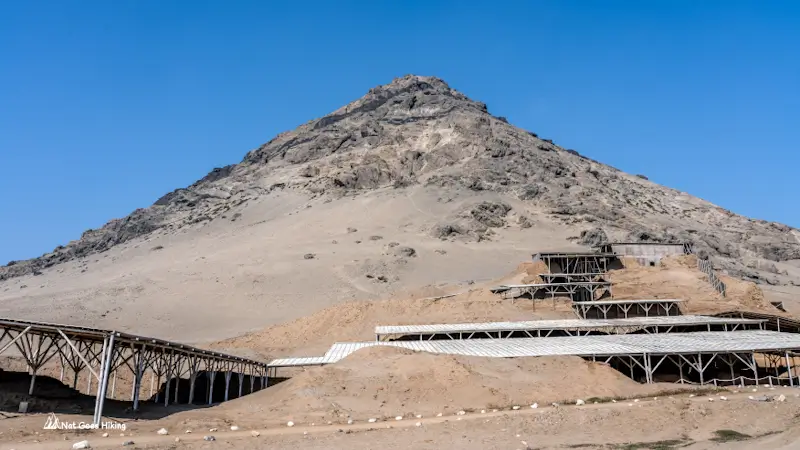
Huaca de la Luna and Huaca del Sol are two huge adobe structures built by the Moche civilisation on the northern coast of Peru, just outside Trujillo. The Moche were a pre-Inca civilisation that flourished in this part of Peru between roughly 200 BC and 700 AD.
The two huacas stand about 500 metres apart, with what was once a city between them. There were houses, streets, courtyards and other areas connecting the two main structures. Huaca del Sol was the political and administrative centre, while Huaca de la Luna was the main ceremonial and religious complex.
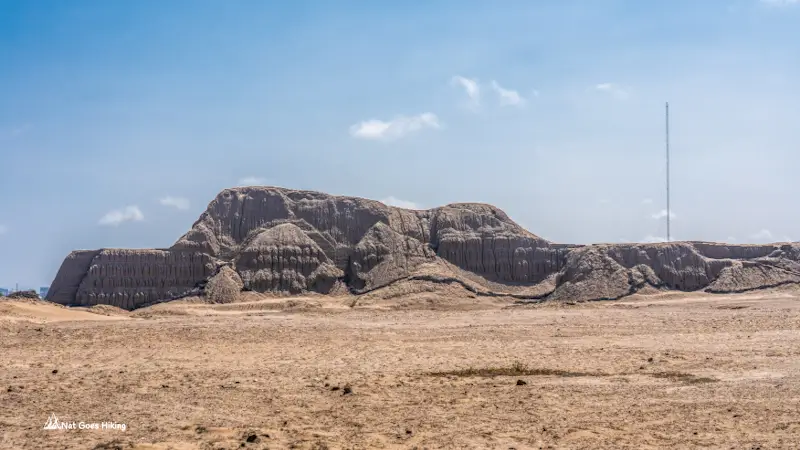
It was really confusing for me. You see Huacas del Sol y de la Luna written everywhere, but you don’t actually visit both of them in the same way. Huaca de la Luna is the one you explore, while Huaca del Sol is viewed from outside. Huaca del Sol is still being researched and is not part of the normal visitor route.
Huaca de la Luna vs Huaca del Sol
Huaca de la Luna was mainly a religious and ceremonial site, while Huaca del Sol had a political and administrative role. They were part of the same Moche city but served different purposes.
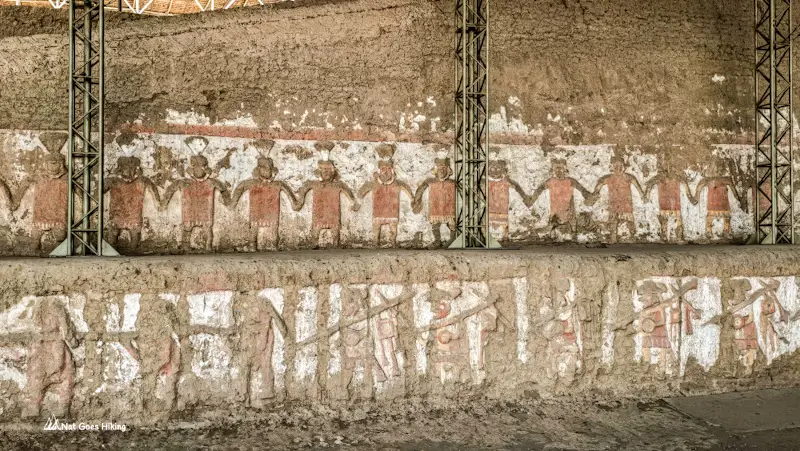
You can only see Huaca del Sol from the outside, while Huaca de la Luna is the one you actually explore, and this is where you can see the colourful murals and reliefs.
Huaca de la Luna vs Chan Chan
If you’re visiting Trujillo, it’s worth seeing Huaca de la Luna and Huaca del Sol as well as Chan Chan. They belong to two different pre-Inca cultures. The Huacas were built by the Moche civilisation, while Chan Chan was the capital of the later Chimú civilisation.
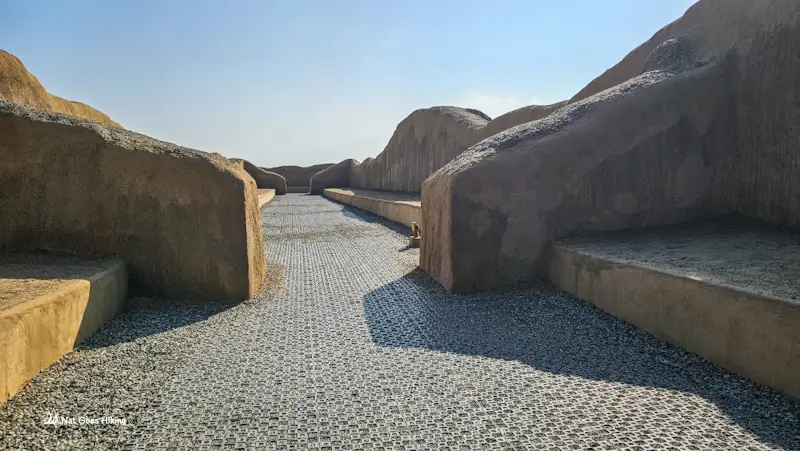
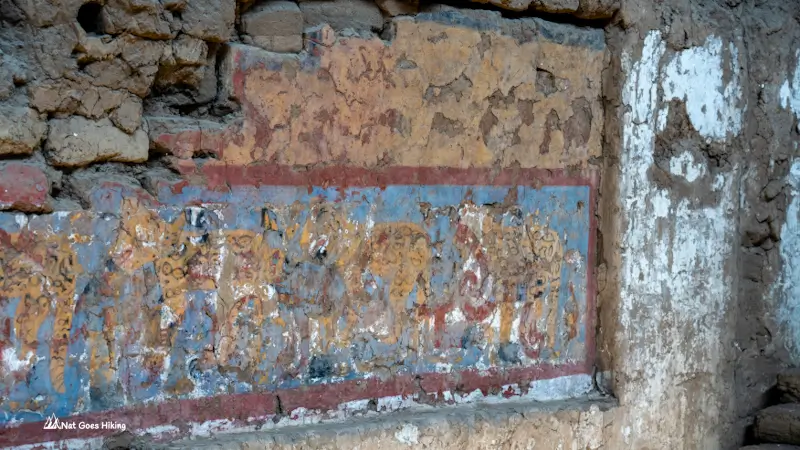
We both found that the experience was quite different too. Chan Chan is huge, with large adobe walls, plazas and different areas of what was once a massive city. At Huaca de la Luna, we found ourselves looking at the details much more. The colourful murals and reliefs are the real highlight. Some of them are very well preserved and have a lot of detail.
If you have time for both, I’d visit both, especially as you can see them on the same day. They’re quite different sites, and I think they complement each other well.
Planning to visit Chan Chan too? Read my guide to visiting Chan Chan independently from Trujillo, including how to get there by public transport.
Can you visit Huaca de la Luna and Huaca del Sol without a tour?
Yes, if you’re travelling independently, you don’t need to book a full tour from Trujillo to visit the Huacas. You can make your own way there, visit Huaca de la Luna with the on-site guide, and see Huaca del Sol from outside.
We visited without a tour, but it wasn’t a completely independent visit. As I mentioned, Huaca de la Luna can only be visited in a group with an on-site guide, even if you come there independently. When you arrive at the entrance, you’ll be placed in a group with a guide.
Huaca del Sol is located right next to the road and can only be seen from outside. You don’t pay any entrance fee to see it.
How to get to Huaca de la Luna and Huaca del Sol from Trujillo
By combi
You can get to Huaca de la Luna and Huaca del Sol by combi. Catch a combi with a sign saying “Mochica Chimu” from Avenida de los Incas near Mercado Mayorista. The fare is around S/2.5-3. TruxDi is a useful site to check Trujillo public transport.
The combi also passes through Óvalo Grau, so we tried to catch it there, but couldn’t find one. Maybe they just aren’t that frequent.

By taxi
In the end, we decided to take a taxi instead. We got a taxi through the inDrive app and paid S/15 to be dropped off near Huaca del Sol.
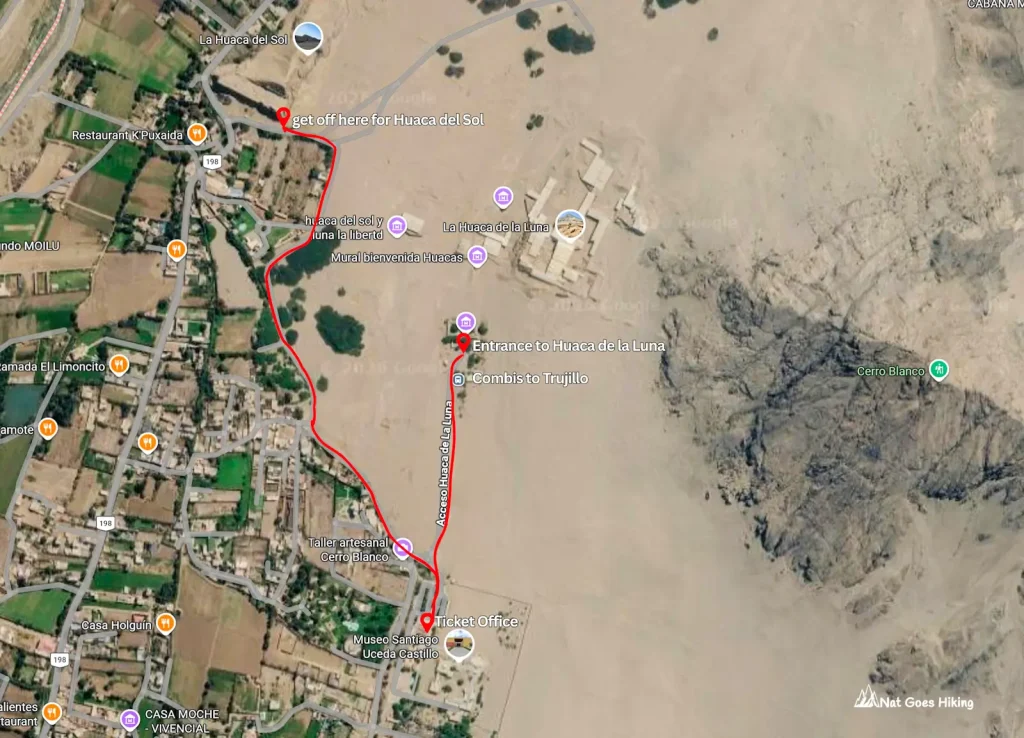
If you want to go straight to Huaca de la Luna, get off at the museum, where the ticket office is located.
We were a bit confused when we arrived because there weren’t any obvious signs. Huaca del Sol is right next to the road, and from there it just looks like this huge, almost solid adobe structure.
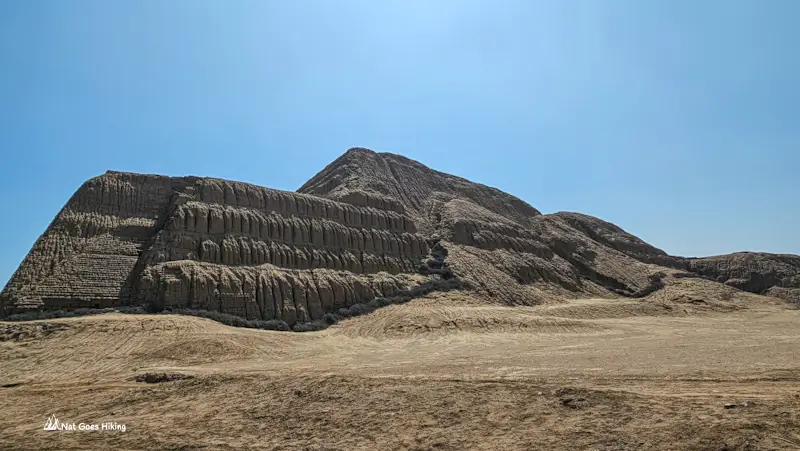
We spent there no more than 10 minutes. After taking a few photos, we headed towards Huaca de la Luna. The two huacas are close to each other, but you still have about 1.5 km to walk along the road to reach the visitor area.
The road actually loops around in a bit of a detour, so we decided to cut across and take a shortcut instead, walking straight through the sand rather than following the road.
Getting back to Trujillo
On the way back, it was very easy to catch a combi. They were parked outside the Huaca de la Luna entrance and heading towards central Trujillo. We didn’t have to wait long and paid S/2.50 per person.
Where to buy tickets and entrance fee
I wouldn’t recommend taking a shortcut if you walk from Huaca del Sol to Huaca de la Luna. As we decided to cut across, we completely missed the ticket office and had to walk there. The ticket office is located outside of the museum, rather than at the entrance to the archaeological site (please see the map above). We then had to walk back about 600 metres to get our tickets.
So, if you’re visiting independently, go to the museum and ticket office first.
The current entrance fee is S/10 for adults, S/5 for university students and retirees, and S/1 for schoolchildren. The Museum of Huacas de Moche costs another S/5 for adults, S/3 for university students and retirees, and S/1 for schoolchildren. Tickets are currently sold in cash.
On-site guides at Huaca de la Luna
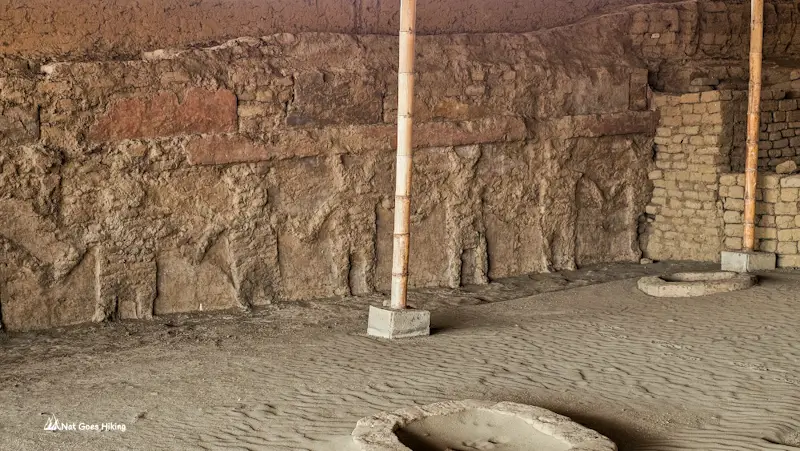
You can’t explore Huaca de la Luna completely on your own. Visitors have to enter with an on-site guide, and independent travellers join one of the groups.
When we arrived, a group with a guide had just left, so we were told to catch up with them and join the group. The group was about 10 people. Our guided visit lasted about one hour, and I felt it was a little rushed. But the guide was very knowledgeable and gave us lots of interesting information about the site and the Moche culture.
According to reviews online, English-speaking guides are available, although they may not be available for every tour. We didn’t ask for an English-speaking guide specifically when we visited, so our tour was in Spanish. If you prefer a tour in English, it’s worth asking at the ticket office when you arrive.
The guides work for tips which are voluntary, and recent visitor reports commonly mention giving around S/5–10 per person. I’d treat that as a guide rather than a fixed fee, though.

Exploring Huaca de la Luna
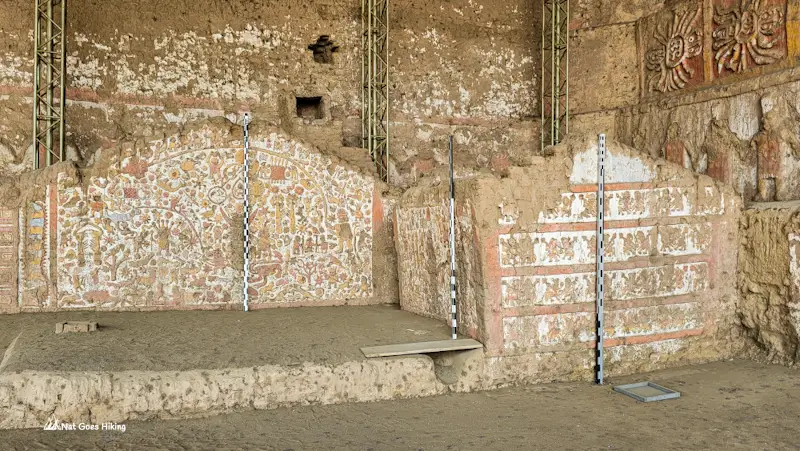
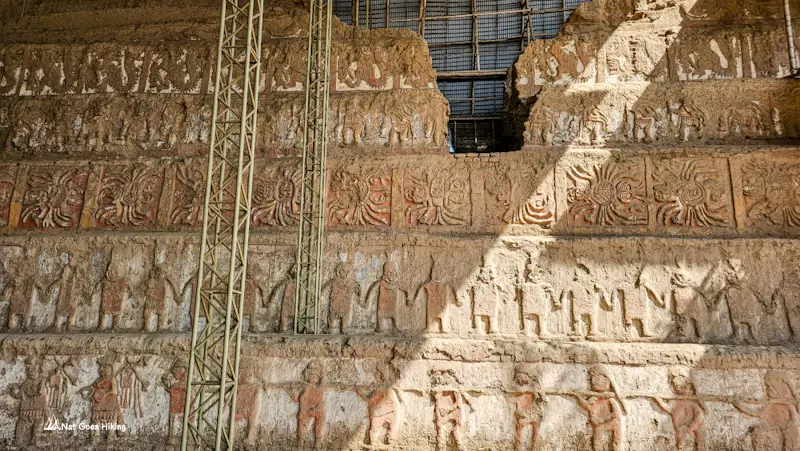
The murals and reliefs were the part I liked most. You can see the colours very well, especially considering how old the huaca is. The walls are covered with figures, animals, geometric patterns and supernatural beings. Some of the reliefs are quite large, and you can quite close to them.
One of the most impressive parts is the north façade of Huaca de la Luna, which has seven stepped levels covered with different scenes. You can see warriors, prisoners, ceremonial figures, serpents, and several Moche deities and supernatural beings. The archaeological project describes the façade as a complex sequence of polychrome reliefs connected with Moche beliefs and rituals.
Unfortunately, when we visited in June 2025, part of the site, including the Patio de los Rombos, was closed while repairs were made to the roof.
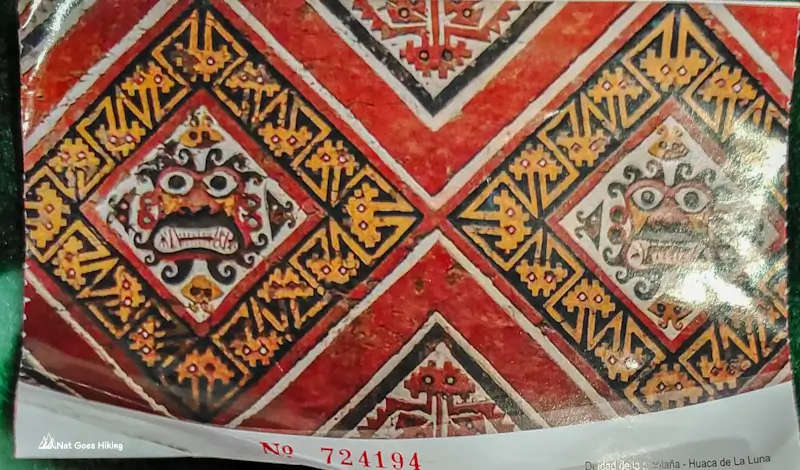
We were both pretty disappointed about this. The Patio’s reliefs of the God of the Mountains are probably the most iconic image from Huaca de la Luna, and it’s the one printed on the entrance ticket. From photos, the reliefs looked very detailed, colourful, and well-preserved, so it was a real shame to miss seeing them in person.
Opening hours
Official hours are Tuesday to Sunday, 9 am to 4 pm, and the last group into Huaca de la Luna goes in at 3.30 pm. Not sure if the guided tours run on a fixed schedule, but we didn’t wait around when we got there. We just tagged onto a group that was starting at 1.30 pm.
So don’t plan your visit for Monday, when the site is closed.
How long do you need at Huaca de la Luna and Huaca del Sol?
Visiting Huaca de la Luna and Huaca del Sol is a half-day trip. Getting there by combi from Trujillo takes around 35–40 minutes. If you get off at Huaca del Sol to take photos, you really don’t need more than 10 minutes. From there, it’s about a 1.2 km walk to the Huacas de Moche Museum, where the ticket office is. You can visit the museum for about 30 minutes before walking another 500-600 m to the entrance to Huaca de la Luna.
Depending on the tour schedule, you may have to wait before joining a guided tour. The tour itself takes around 1-1.5 hours. Ours was only an hour, although I think it was shorter because some parts of the site were closed when we visited.
Allow around 3-4.5 hours in total, depending on whether you come by taxi or combi, visit the museum, how quickly you walk and, of course, how your timing lines up with the tour schedule.
Our visit took just 2.5 hours. We came by taxi, skipped the museum, joined the guided tour without waiting, and got straight onto a combi on the way back.
Is Huaca de la Luna worth visiting?
Yes, I think Huaca de la Luna is absolutely worth visiting. Together with Chan Chan, it was one of the highlights of our time in Trujillo. And the two sites are quite different from each other. Chan Chan is vast, while Huaca de la Luna is a much smaller site where you can get close to the colourful Moche reliefs and paintings.
The guided visit to the huaca lasts about an hour, so you don’t need a whole day for it. We visited Huaca de la Luna, Huaca del Sol and Chan Chan on the same day, which worked well and left us time to see other parts of Trujillo.
One disappointment was that the Patio de los Rombos was closed when we visited in June 2025. This is where some of the most famous reliefs are, so we were both quite disappointed about that. The good news is that recent visitor reviews include photos of the reliefs, which may suggest this area is now open again. So it’s worth checking the latest information before you go.
If you don’t want to deal with the transport and logistics yourself, you can also find Trujillo tours that visit both Huaca de la Luna and Chan Chan in one day.
FAQ
Yes, you can visit all three in one day if you start reasonably early (we started around 9 am). We did it in one day and it wasn’t too rushed. We began at Chan Chan spending about 2.5 hours, including the museum, then had lunch in Trujillo before taxiing to Huaca del Sol and Huaca de la Luna, which together took a few more hours depending on whether you visit the museum and how long you wait for the guided tour.
If doing all three independently, allow a full day. Note: last entry to Huaca de la Luna is 3:30pm, and both sites are closed Mondays.
Huaca del Sol is not part of the normal visitor route. You can see the enormous adobe structure from outside, but Huaca de la Luna is the huaca you actually enter.
No. You can travel there independently from Trujillo. However, you still need to join a guided group once you arrive at Huaca de la Luna.
Yes, there are toilets at both the entrance to Huaca de la Luna and the Huacas de Moche Museum. I remember them being free to use when we visited.
The entrance fee is S/10 for adults. University students and retirees pay S/5, while schoolchildren pay S/1. The ticket for Huaca de la Luna is separate from the Huacas de Moche Museum, which costs S/5 for adults.
You buy the tickets at the ticket office located in front of the museum, and payment is in cash only.